Sunday, February 2, 2014

Tver - Gateway to Moscow

Adam stood shaking his hands to get some warmth back into them - his elegant, Italian leather gloves more of an adornment, rather than fulfilling the purpose he'd purchased them for. A burly, elderly man laden with bulging plastic bags stopped to address us with a smile, "Da, da, russkaya zima." We both burst out laughing; a remarkable effort, tensing and stretching the skin on our faces to cracking point. He was right; "Russian winter." Ironically though, it wasn't winter yet, not by the calendar anyway. It was still fall, but it felt no different from a very cold, winter day. On our way from the train station to explore the city, I wondered about the chore that lay ahead of us in the very low temperatures - sight-seeing.

Treading on lumps of ice and piles of snow, braving sub-zero degrees weather for the sake of exploring a city, required more than willpower. Even determination came short of what was required to embark on a journey of that kind. Reminiscing about the trip a few weeks afterwards, Adam admitted that the walk back to the train station was very tedious - it was unbearably cold, the walk was difficult and interspersed with the occasional slips threatening to send you onto your rear-end, not to mention the laborious effort of trying to keep our extremities warm. I was relieved to know I was not the only one who had felt that way. The next morning, I was so sore, it felt like I had tried out a new sport using muscles I didn't know made up part of my body.

Everyone I had mentioned visiting Tver to gave me a quizzical look. One person said she'd been but had not enjoyed it, another person from a town close to Tver recommended visiting another town, others just said it was a waste of time as there was nothing to do there. Curiosity had gotten the better of me, fuelling my inner drive to make it in time for the 08:09 train leaving Leningradsky Vokzal, to embark on the two and a half-hour journey to Tver. As I made my way there, I thought, "Who wakes up in the middle of the night in winter weather, in Moscow, enough said, to visit a town no one else wants to go to?" There ended up being takers on that one - another victim and myself.

Surely, to have several locations in Moscow named after it, Tver must be of a certain significance in Russia, at the very least in history, I thought. Tverskaya Street in the trendy part of Moscow, Tverskaya metro station leading to the trendy part of Moscow, Tver Hotel now taken over by a well-known multinational chain, but with a preserved air of the bygone era, Tverskaya Zastava, a square in front of Beloruskaya metro station... and possibly a few other places I don't know about yet. There had to be a reason why these places were named after this town. Not to mention that the Sapsan, the Russian high-speed train between the two largest cities in Russia, Moscow and St Petersburg, makes its only mid-trip stop in Tver.

Despite my reasoning, whomever I asked, gave me a similar response: "There's nothing there worth seeing." "There's nothing to do there." Needless to say, my invitations to explore Tver were mocked or met with raised eyebrows - "What on earth for?" Well, Catherine the Great certainly thought it fit to build a palace there for a stop while traveling between Moscow and St Petersburg. The said palace is currently under renovation. She is said to have actually donated a million rubles to build the road her carriage would travel along, known as Million Road.

One of the conductors on the train, a friendly one, asked if we were tourists visiting Tver. He must have been as baffled as others who could only surmise our mission at our  destination. I confirmed his suspicion and complimented him on his English. He mentioned that he'd lived in India for three years as a member of Hare Krishna. With his current full head of dirty blond hair, dressed in a heavy blue uniform, I had difficulty picturing him with a shaved head, robed in a saffron sheet, metal bowl and pestle in hand, chanting rhythmically in a language unknown to me. There was no time to chat, unfortunately, about his experience in India and why he had made the swap back to Russia.

Off the train, finally in daylight, our initial goal was to head for the cafe recommended by a woman on the train who had changed seats to be closer to us. She had heard us speaking English and wanted to be closer to get a chance to exchange a few words with us, or so I supposed. When she did get the chance, she inquired about the purpose of our existence in Russia, which initiated an exchange of impressions about Russia and other places. A native of Tver working in Moscow, she was able to recommend a cafe where we could have lunch and was adamant about us trying the strudel, a specialty of Tver, she informed us. Her response to our request of things to see though, unlike her recommendation for the strudel, was devoid of enthusiasm.

We stopped at a book and stationary store on the way, indulging in what it had to offer. Books are generally very reasonably priced in Russia, and are my weakness. A few greetings cards and some books afterwards, we had managed to warm up a bit, catch our breath and were ready to make it back outside. Bundling up tightly once again, we made it out onto the street ready to trek to our destination - 'Mon Cafe', as recommended by the lady on the train.


Braving the elements and following the map we'd just acquired from the bookstore, we headed to Tryokhsvyatskaya Street, a pedestrian area lined with shops of various merchandise - some open, some about to open, cafes, restaurants and a lively crowd. Further down, we came to the real star of this area - a bakery dating from the 19th century. It certainly warranted a visit. The facade clearly portrayed the era of its heyday. Inside, it was more than just a bakery. Traditional baked goods of all kinds clearly dominated the store in addition to two small round tables with chairs for a quick snack and drink . However, groceries, cold cuts, packaged goods, teas and coffees of different brands had now made their way into the no-longer-exclusively bakery. Nonetheless, the star was the bakery section - cookies, strudels, biscotti, buns, breads of different grains ... all much better priced than in Moscow. Needless to say we stocked up; in my case more for gifts than for personal consumption, and had a well-needed warm drink to tackle the next leg till we reached our destination.

In addition to the variety of goods as an attraction, one of the walls was decorated with pictures of various stages in the life of the bakery. Staff in different era identified by the fashion of their clothes stood in line for these stills in black and white immortalized in frames. Just like the country, it had experienced its fair share of change from before, during and after royal, revolutionary, socialist and current times. It was a significant discovery that neither the conductor nor the woman on the train had mentioned; once again showing what individuals consider worthwhile or not. It had been another stop to warm up.

Back on the street, we encountered an old man on a bench, feet on frozen snow surrounding him, playing a well-known Russian folk song with a catchy tune on an accordion. I have always considered street musicians in Russia very brave, but then again, they are a sturdy bunch. Most people walked past him. We stood for a short while to enjoy the song, keep him company and drop a note in his pan. He rewarded us with a warm smile which must have emerged from the depth of his heart. Wrapped in layers of clothing, topped with a fur hat as his bare fingers nimbly glided over the buttons and his arms extended and contracted the flexible instrument, he did not object to a picture and asked us to come back soon.

The third stop didn't warm us up and we were still a fair distance from the recommended cafe. The pedestrian street opened on to Soviet Square, the arts area, with theaters forming a semi-circle and Lenin ingratiating the passers-by from the other side of the square in a salute from his extended right arm. We were finally in the town center. Million Street, now Soviet Street was not too far away, and neither was Mon Cafe, but we made a stop at a church before finally walking through the doors of the place where we would spend a couple of hours recovering from the walk and the cold.

I had assumed it would be a short and straightforward from the station to the cafe, and then to the river bank along which all the sights are located - the reality was quite different. It was actually tempting not to spend the rest of the day in the comfortable chairs, making order after order of dishes, which would cost about three times more in Moscow, served by staff friendlier than I am used to.

I certainly tried the strudel, two servings - blackberry and apricot. They were both delicious. Tea. Shakes. More tea. My companion had coq-au-vin which he raved about - not only because of the taste, but the price for such a succulent dish. Soft, freshly-baked rolls. More fruit shake. Tea. Eventually, we had to get back outside to see what Tver was about and fulful our purpose of the trip. We piled the layers back on and once again ventured out into the cold unknown.

We crossed the road and waited for the woman on horseback to pass before we walked through the gate to the park. It was all covered in snow - the trees, benches, monuments... we even made and threw a few snowballs. The sunny weather brightened the cold walk to the 3,530-kilometer Volga river on its way through Tver to meet its diminutive partner the Tvertsa. The chance to see another monument of Pushkin standing quietly, full of purpose, people-watching, in his top hat and coat, legs crossed, leaning against a metal railing as he had done from time immemorial, and the neoclassical buildings reflected in the water by the sun up high were enough to make the trip worthwhile. It was quiet in the park and the chance to take in this view undisturbed was priceless, except when Adam decided to roll down the hill almost into the water because the soft, powdery, fresh snow was simply irresistible. He paid the price alright, as the snow covered his thin jacket, got into his clothes, stuck to his skin and dampened his clothes for the rest of the day.

The embankment, considered the heart of the city, is lined with neoclassical, pastel-colored, 18th century architecture, as well as trees and parks of statues. A monument to Afanasy Nikitin, a native of Tver is a graceful addition on the embankment. He is said to be one of the first-recorded Europeans to go to India, penning "Journey Across Three Seas" which became a famous travelogue. He stands astride, facing a long-spire church which seems to be the style favored in Tver, over the onion bulbs.

Two other significant monuments in Tver, in my view, are the two bridges which straddle the Volga. We managed to walk across them both in different directions enjoying the views of the city from different angles, admiring their reflections in the water. After short visits to a couple more churches, it was time to head back to the station. It is this walk that will stay engraved in my mind, and as I walk around certain parts of Moscow in winter, such as my neighborhood, I am forever reminded of that day in Tver.

With no more enticing pit-stops on the way back, the walk from the embankment in Tver to the station was not only long, but painful. The beautiful sun which had kept us company during the day had set. It was bitterly cold. The roads had not been cleaned and what seemed funny at first on our way in as we slipped and laughed was funny no longer. It was a task of endurance. My state of relief back at the train station was immeasurable.

It had been a pleasant adventure, but one that I am in no hurry to repeat, although I will remember the friendliness of the natives of Tver very fondly. I felt for the elderly in Tver, and in many other towns across Russia in similar conditions for several months of the year. I wondered if they would be used to it having lived there all their lives. I feared for them falling, and the conditions a fall on ice would leave them in. I remembered the heavily-laden elderly man who had cheerfully addressed us earlier on in the day as he walked on the same road I had incessantly complained about.

On the other hand, I saw young children running, jumping and skidding on the same ice that I was treading carefully. Maybe I needn't worry after all. These people are resilient and can take it all in stride, no pun intended. They made it through serfdom and Soviet times under the name Kalinin. It must be in their genes, so I think my concerns may be unfounded.

The 160-km train journey back to Moscow was uneventful. Not many people were rushing back to Moscow on Saturday night. However, our companion on the way in, who recommended Mon Cafe ended up being on the same train back to Moscow as us. Her plans had obviously changed as she had mentioned that she was staying for the weekend.We nodded in acknowledgment to one another, but this time we sat in different cars. Tver had taken all I had and I was in no mood for polite conversation. My joy new no bounds when I turned the key in the door to my apartment and limped to my bed.

Monday, January 27, 2014

Hidden Treasures in Moscow

It's all here, for all tastes; museums, art galleries, restaurants, cafés, theaters ... Moscow is a lot of things, but never boring. Offering infinite opportunities to savor culture in all its forms, sometimes these places are not easy to find. From alley way to alley way, buildings numbered haphazardly, not very helpful GPS devices, passers-by who have never heard of the place you may be looking for...but eventually you make it there and marvel at the magnificent spectacle before you.

One such place is The Moscow State Museum Bourganov's House in the heart of Moscow, not too far from Arbat Street. After you have finally found the place, at the sight of the nondescript entrance, you first wonder if the hard work was worth it. But once you venture in, you don't need anyone to answer the question for you. One look around and you know you made the right decision to visit 15 Bolshoy Afanasievsky.

The small door leads into a small reception area and a minuscule bookshop, where a small fee of 100 rubles gives you access to an open-air museum. A plethora of life-size sculptures of feet, hands, eyes, waning moon busts, busts with different motifs await to be admired. I couldn't help thinking I had walked into the world of a Russian Dali. Not having any initial expectations, my first impression was greater than what I'd felt going to the Dali Museum in Cadaques.

Unlike the time in Cadaques, where I wondered around comfortably in light clothing, here it was the beginning of winter. All bundled up, devouring these masterpieces, my fingers turned numb from the endless clicking to immortalize my visit. Despite the discomfort, it was difficult to leave. Every step led to another wonder.

In one building we met a kind security guard who took us behind the scenes to show us the work of restoration going on and where new works of art were being created. The shelves were stacked with a variety of art works amid the chaos which usually characterizes a busy art studio. He showed us around the temporary exhibition of canvases imitating a version of impressionism - unfortunately the gloominess depicted in the paintings did not help much to brighten the atmosphere. A small basement featured an atrium where a framed print of Dali's "The Great Masturbator" as well as smaller versions of the life size sculptures featured outside were on display. A few chairs gave it an appealing air of a quiet reading-room where you'd be surrounded by valuable creations.

And it went on. Shoes, bathtubs, arms, chairs...the neighbors whose windows looked onto these sculptures, in my eyes, were some of the luckiest people in Moscow. Living in the heart of the city with a view of exquisite art; waking up and going to bed with a view over spectacular beauty.

Two hours later, we finally made it back to the warm reception area where we engaged in conversation with the friendliest museum attendants I'd ever met. The receptionist showed us what was on sale - some very expensive jewellery, but also some very affordable books and calendars. In the course of our interaction, she informed us that a few years ago, Pierre Cardin had brought his models to this museum for a photo shoot. She showed us the pictures of the event published in a coffee table book; very impressive. I had no difficulty imagining the whole setup of elegant models in elegant clothes posing by, on and among the surreal sculptures.

She also told us about the artist himself and his beginnings. "The killing of a bird" is apparently partly biographical, explaining the ideas behind the works of art Alexander Bourganov had created. I bought the book to get some more insight into it, making a note to inform others about its existence. The art teacher at my school was grateful to receive the information and mentioned a possible field trip with her students for exposure to more works of art. We had been told that it was visited more by foreigners than by Russians, sadly. The bronze Pietà was my favorite - the loose folds of fabric and the semblance of a body lying across the mother's lap is a heart-wrenching sight.


Alexander Bourganov's works are spread all over the city. The walk from Kievskaya metro station to the Radisson Hotel, formerly the Ukraine Hotel, with a restaurant on the 29th floor and the Mercedes bar on the 30th, offering some of the best cocktails in the city, takes you through a park showcasing beautiful sculptures. The first time I ventured onto the park, I was happy I had my camera - a fountain with a highly-perched golden angel drew my attention, as well as other more somber bronze and stone sculptures. I wondered about the fortunate dwellers of the apartments overlooking these magnificent works of art.

Similarly, a walk in Arbat street takes you past the golden Princess Turandot and the Pushkin couple in front of which tourists and Muscovites alike are forever striking a pose. The beauty of these works of art are irresistible and one cannot pass by without devoting a few minutes to admire them. I was to find out after the visit to The Moscow State Museum Bourganov's House that all these works of art are Alexander Bourganov's as well.

He is still alive and well, still working, still creating, I was told. The attendants were just too happy to have someone to share this information with.

After a morning feeding the soul, it's time to feed the body, and take in another form of art. Pioneer movie theater in Kutuzovsky offers movies, good food and food for the mind. I'd been told it was a theater where movies were shown in the original language, but I hadn't been told about the décor. I can't imagine its size as a movie theater if it has now been refurbished and fitted with a restaurant on two floors and a bookstore.

With the low temperatures outside, I appreciate the opportunity of several activities under the same roof, not to mention that anywhere I can find books is my personal haven, and Moscow has lots of such places to offer. Dom Knigi on New Arbat Street and its smaller version on Tverskaya are my favorite hangouts. Pioneer Cinema in Kutuzovsky is another piece of treasure in this mine.

We chose a comfortable seat after trying two others and had the place to ourselves. Our kind, attentive waiter made the experience of a light meal before the movie a delightful experience - stir fry chicken, almond cookies, honey cake, mulled wine and two good servings of ginger tea, all promptly served in a welcoming atmosphere, honoring the taste buds. "All Is Lost" starring Robert Redford restored my faith in not giving up hope, extending the pleasant experience further.

A trip to the bookstore at the other end of the hallway with a 10-meter ceiling, at least, was a must. The three chandeliers of elaborate work on the high hallway ceiling are probably the only vestiges of the Soviet-era after the building was refurbished. The small, well-stocked bookshop did not disappoint me. The only time I do not complain about prices in Moscow is when I buy books; be they in Russian or English, and this time was no different. I bought a text book "English for Banking" for 38 rubles, and a novel by an Indian writer for 137 rubles. My excitement knew no bounds as I considered the value of my acquisition - just about 5 dollars.

Meal - check, movie - check, books - check, and back out into the snow in double-digit, subzero temperatures. We retraced our steps to the metro station past the French signs on stores selling extremely expensive and unnecessary goods. La Cornue was a kitchen gallery, a pink velvet bedside table with very long legs was displayed in the window of Bonpoint, as well as a white dining table of indiscernible material and accompanying red velvet chairs, Fleurs de Paris informed passers-by that it was open 24 hours.

Finally, the Museum of Architecture which is just a stone's throw from Arbat metro station is worth a visit; if not for the display of the new plans to restructure the city, for the buildings themselves - three. The main building housing displays of new plans for the city on flat screen TVs offers a view of the classical, Soviet-style building - high ceilings, marble floors, elaborate chandeliers, shiny, wooden balustrade supporting wrought-iron rails as you go up the grand staircase, arch doorways, and in this case, frescoes on the ceilings as well as marble reliefs, contrasting tremendously with the flat screen TVs displaying ever-changing slides.
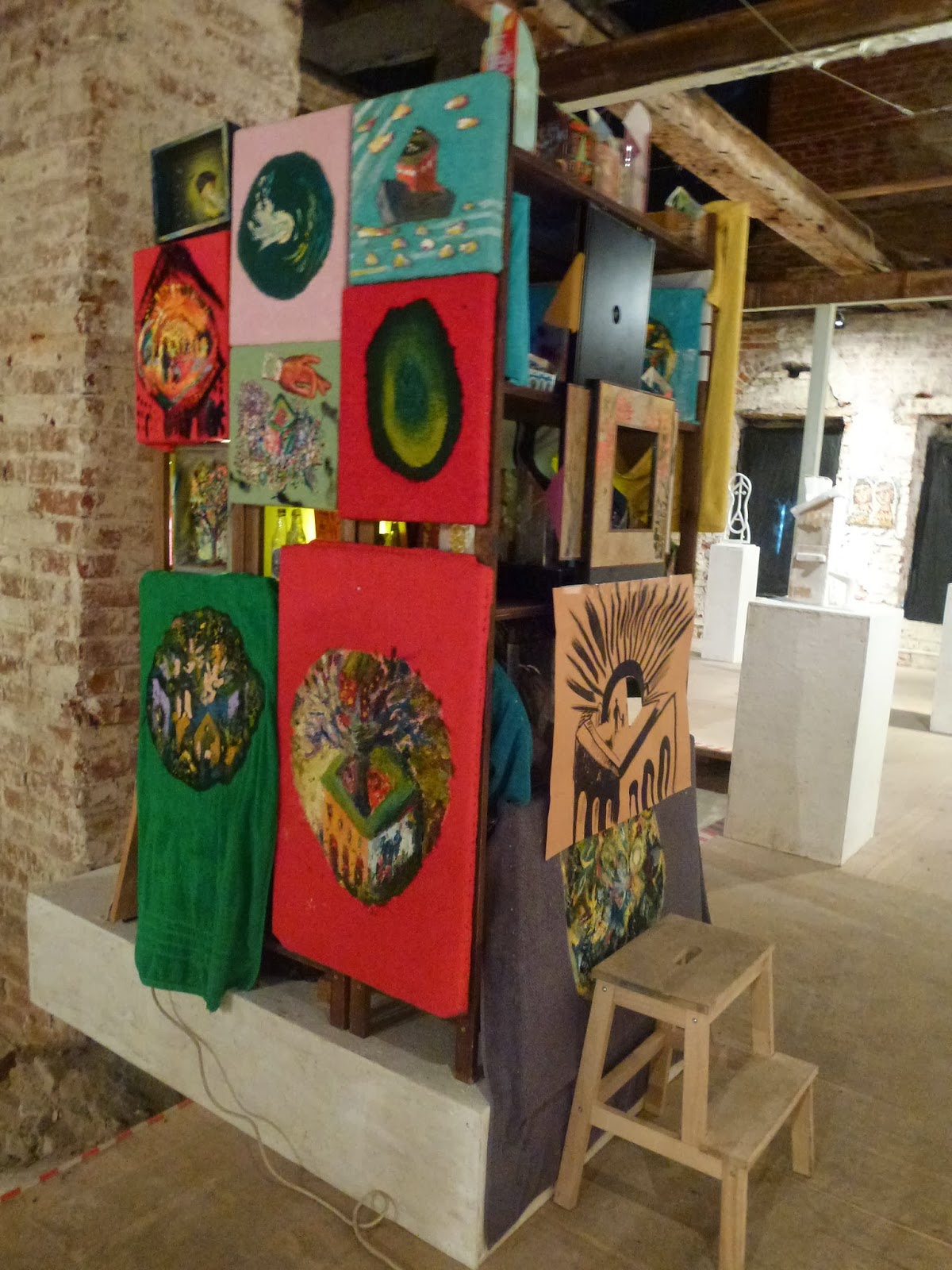
I was grateful to the woman for suggesting we put our coats on to go out to the next building. It had been gutted and offered no protection whatsoever against the biting cold which our coats had difficulty protecting us against. The exhibition theme was religious, and eclectic - naif-style, religious paintings, wooden, plastic and metal sculptures on wooden stands, fabric, and more of those underground. Following the religious theme, included in the display were several models of Orthodox style churches - some built from scratch, others restored. The main attraction was a laptop on a shelf shielded by paintings on multi-colored fabric - a small step ladder was provided to climb on to see what the electronic gadget displayed. Unfortunately, there were no attendants to offer any information and none was provided.

The third building, surprisingly warm, displayed architectural styles of buildings in Moscow inspired by or copied from those in other cities mostly in the Netherlands. Finding the buildings in Moscow would be difficult as no addresses were provided. All in all, it had been a worth-while visit during which we spent over an hour admiring the various displays.

These are just three of the several treasures housed in this megalopolis called Moscow.

Monday, December 2, 2013

Small Town, Big Parade - Yaroslavl

The parade had ended, enabling the soaked dignitaries, most likely chilled to the bone, to finally disperse. The forlorn lectern on the rolled-out, T-shaped, red carpet with golden borders offered an unusual view. There was no one on the carpet which lay soaked on the ground in the incessant drizzle in front of the grey, Soviet-era, block-shaped building with the scythe and sickle boldly emblazoned on each side, shielding the bear carrying a tied bundle at the end of a stick. The bronze bear must have been added recently as the story behind it pre-dates Soviet times.

Across from the wide square and the modern building, was a replica of a multiple, green-domed white church I had seen in Kolomenskoe Park, the royal retreat in the apple orchard outside Moscow - a reminder of another visit.

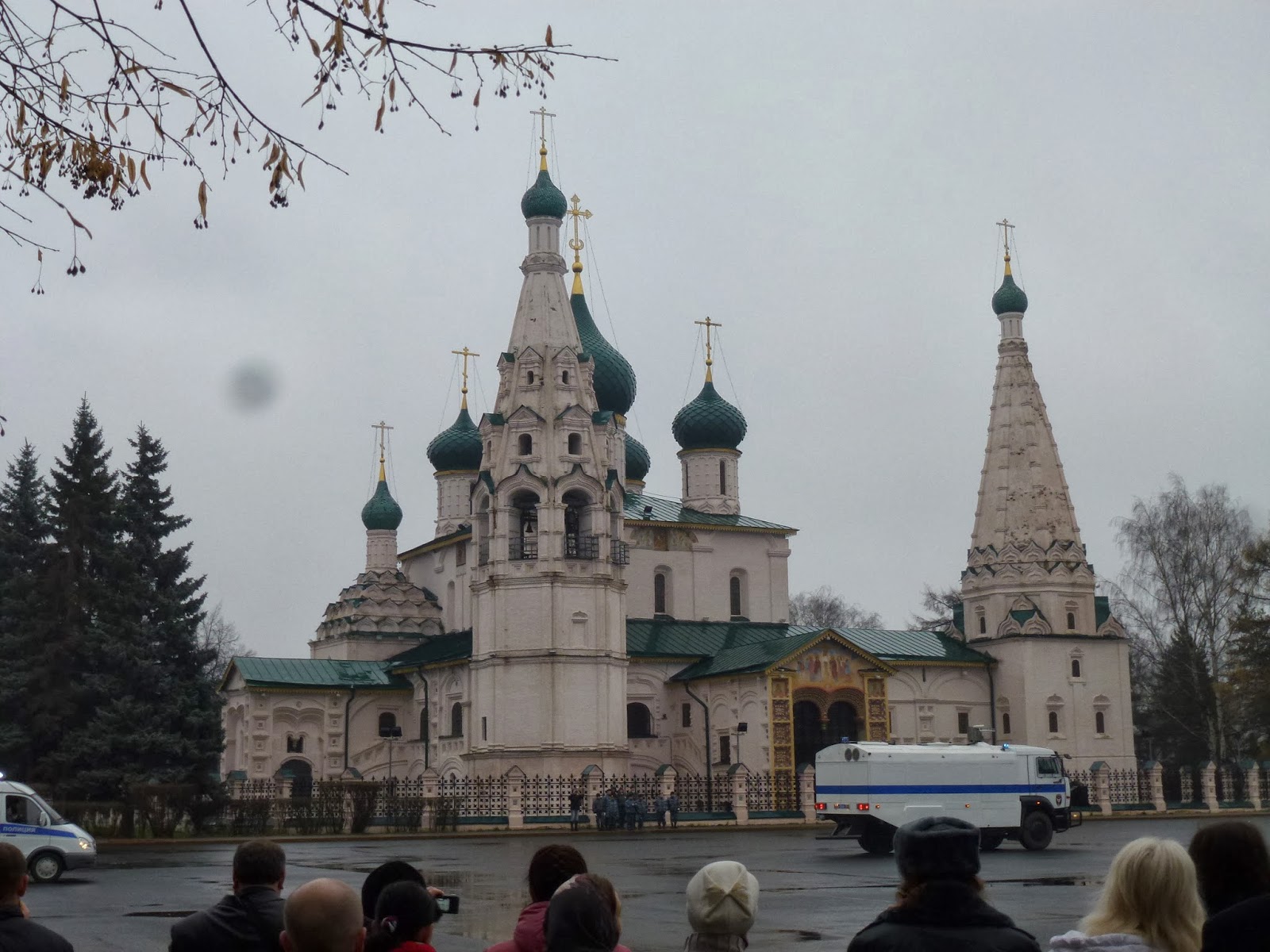
The big boys had been recruiting more boys to come and join them play macho games with their big toys. Or so it seemed from the parade of companies or battalions followed by police cars of different sizes and makes, military trucks and tanks and a myriad other big vehicles. We managed to catch a view of the last cadets and officers marching through the square to the dynamic rhythm of a marching band, as a loud speaker blurted out the names of the companies and invited others to join this exclusive brotherhood of municipal, regional and national defense. All through the light drizzle, men, women, families, children sitting on the shoulders of their loved ones stoically and silently watched the parade embodying respect for the demonstration of such power.

Yaroslavl, where we'd gone for the weekend is a leisurely, three-and-a-half hour train ride from Moscow. The scheduled train rolled out with admirable punctuality; so much so that one of my co-travelers who made the mistake of arriving a few seconds after departure time was left behind. We found our seats easily in the last car and slid cozily into their warmth in contrast to the wet weather outside, making for a nice opportunity to catch up on sleep we had been deprived of due to the early departure.

Our initial goal, upon arrival, was to find our sleeping quarters, leave our luggage, have breakfast and then tour of one of Russia's oldest towns, which in 1612 had had the honor of being the capital of the Russian state for about two months. Having celebrated its millennium in 2010, it is slightly older than Moscow, which is just a bit short of 900. Included in the UNESCO World Heritage list since 2005, its historic center boasts numerous, beautifully restored churches accentuating the traditional air so typical of the Golden Ring towns in Russia.

From the train station, we walked along Chekhov Street to a nearby hotel we hoped would serve us a well-needed meal as it was almost noon. Our excitement heightened with every step towards the hotel as we imagined a warm restaurant with a smorgasbord to fill our plates to our hearts content; what with the weather, our hunger and anticipation was immeasurable.

Had anyone managed to capture the disappointment on our faces as we were informed by the security officer that there was no such place for dining at the hotel, not even a coffee shop, we would have made the front page of the Yaroslavl Times. A hotel, in a tourist town of such prominence, without a simple coffee shop, was difficult to digest. Dejected, we plodded away with heavy hearts and empty stomachs in the hope of finding a coffee shop in the vicinity. We didn't. The only attraction in sight was the old cemetery that the hotel rooms looked on to. An imaginary conversation between a visitor and reservations clerk played in my head - "Cemetery view from your room, or...cemetery view?"

We continued our walk along Chekhov street, past the cemetery, a jacuzzi tub sales center, old houses, tram tracks...no coffee shop in sight, nor anything remotely offering sustenance.

The sophisticated hand-held device informed us after 3 kilometers that we had another 3 kilometers to get to our chosen accommodation site to leave our bags. The general consensus after the disappointment, the long walk, and the further exercise that awaited us was to get ourselves to the town center instead, where the likelihood of finding a place to sit, eat and rest before tackling the tour seemed more plausible.

We waited at a stop for a bus headed in that direction and boarded one after about 18 minutes. Held up in traffic close to the town center, we finally found out why - a woman who had been run over was being carried into an ambulance as she lay face-down, fully-clothed on a gurney. My thoughts went out to her. As much as I'd complained about breakfast, or its lack thereof, the walk, and everything else, at least I was on my own two feet. I wished her a speedy recovery as I realized how lucky I was. The scene reminded me to be careful while crossing.

Finally we arrived at our destination to be welcomed by vestiges of the products of the legendary revolution - Soviet Square, October Street... and right in the vicinity, oh joy, a coffee shop promising a spread. We entered the Travelers' Cafe and sank into the soft seats like the weary travelers that we were. Always an interesting experience, the order and service did not disappoint us, with the lengthy service, the wrong order, the cold gazes and the accompanying squabbles. I am now used to it and just take it all with a pinch of salt.

Our first stop as tourists, once well-fed and after walking along a boulevard bearing a name commemorating the Soviet era, past a colorful collection of birdhouses in bright pink, purple, white, blue and emerald green all nailed to a tree, was Volkov Theater in Volkov Square. The pastel yellow building with white columns, typical of the neoclassical architecture found all over Russia, looked newly restored, sporting a fresh coat of paint. Both are named after the founder of Russia's first public theater, Fyodor Grigorievich Volkov.

We walked around, past Blaise Tower and to the pedestrian area with chain stores, a beer den or two, churches and several monuments. My friends, like most Russians I am acquainted with, are not particularly interested in entering churches. This has been conveyed to  me in different ways: "I don't have a scarf." "We can't go in wearing pants." Or simply more directly, "there's nothing interesting to see inside." As such, I only admired the churches from the outside.

More churches, more church bells, more golden domes, more pastel yellow buildings and their corresponding white columns, as well as the omnipresent eternal flame with wreaths deposited by thoughtful visitors. Bordered by the Volga and Kotorosl rivers, we walked along the embankment as the weather warmed and dried up in the afternoon. In the midst of all the history and the pleasantness of it all, I felt bewitched by the spell that the beauty of the historic town center seemed to have cast on me. The summer months long over, there were no cruise ships at the harbor as the guide had specified.

There wasn't a single moment during which the gigantic "I heart Yaroslavl" sign did not have someone posing in front of it. Standing in line for a souvenir did not appeal to me so I took a rain check. Good weather being hard to come by, I thought I'd make the most of what we were lucky to get. The one picture I had taken of myself was with my hand on the man-size rock displaying the inscription of the founding of the town with the monument of the Holy Trinity erected in 1995 in the background.

As we returned into town after wearing out the soles of our shoes for a few hours, we heard church bells. It was four o'clock and the faithful were being summoned to mass. We approached the church and stopped to listen to the musical chimes which, to my surprise, were the product of a woman's expertise. It was the first time I'd seen a woman in the belfry instead of the usual long-haired, long-bearded, black-robed, kamilavka-donned priest. We looked up at the woman in a black dress and headscarf, enjoying the music her hands so deftly played, as she looked down at us. And I was sure she could see the "box of chocolates" a prankster had left on the ground trying to lure fools in pursuit of satiating their gluttony, subsequently disappointed as they discovered the trick. The bell concert lasted five minutes exactly - five minutes of musical bliss.

We resumed our walk back to the pedestrian area, where we found a place for a snack as we prepared to accompany our friend who was returning to Moscow that evening. Night setting in early, there was little else to visit at the end of the day so we decided to watch the latest Russian release in the movie theater, about a geography teacher who regularly enjoyed a couple of drinks too many, and then have dinner.

It had been a tiring but rewarding day with lots of interesting sights in great company. And now to find the accommodation we had tried to get to when we first arrived several hours ago.

The next morning we made our way, once again, and for the last time, to the pedestrian area. "Le Gavroche,"
which we later discovered was the in-place in Yaroslavl for a meal, is where we found a booth and settled in ravenously. It was decorated beautifully with semi-open, rich, dark curtains bunched up on the sides, revealing the on-goings on the street, or in this case, the none-goings. Framed pictures of Yaroslavl at different times in history gave the coffee shop a homey feeling. Posters of different beverages vividly indicated the business the place was in. Very few tables were occupied with people generally talking in hushed tones. It seemed the perfect place to spend some time in the morning before heading back to Moscow.

Omelette, pancakes with sour cream, broth, strudel, croissant, fried eggs and ham, tea...we seemed to be celebrating; such was the sumptuous breakfast we regaled ourselves with. It seemed very quiet; quieter than a normal Sunday morning. There didn't seem to be many people walking outside either. We later saw the whole town gathered at the square watching the big boys' parade with their big toys and understood. We had arrived in time to take part in the end of the event, listen to the officer calling upon the brave to join the forces, and for the barricades to be lifted so we could walk through and discover what was left on our list.

We walked past a posh grocery store, which time did not allow us to explore, on our way to the Monastery of the Transfiguration. It is, according to the guide, the best place to start a tour of Yaroslavl. However, we had left that for last - the thick, white-washed walls, arches and brown-roofed towers at each corner, vividly reminiscent of other monastery ensembles all over the country. A sign at the entrance informed visitors of its status of a UNESCO World Heritage site charging different fees for access to different sites within the ensemble. "Masha the Bear" was on display for a few hours in the afternoon for a few rubles. Did she dance? Ride a bike? Skip rope? What tricks, I wondered, did she do enabling her to be on display? But, alas, I didn't have the chance to witness it.

A light, constant drizzle filled the air as we paid a small fee for the privilege of visiting the grounds, but not the finest creations of medieval Russian art housed in the churches. I promised myself I'd do that on another occasion. It is said that nothing of the Kremlin survived when it burnt down in 1658, nevertheless, a collection of beautiful churches and monuments make it worth visiting. I hadn't managed to see the Abbott's Chambers, the Refectory, the Holy Gate and other recommended attractions, making a visit back paramount.

We bade farewell to Yaroslavl the town, and to Yaroslavl the Wise, whom we have the good fortune to see every time we spend 1000 rubles. In the town, he is cast in bronze and was erected in 1993, holding a model building in his left hand.

We made it back in time for the train, which once again left promptly with no announcement whatsoever. Busy playing scrabble, scattergories and reading, the train ride was over in the blink of an eye, as was the weekend.

Friday, November 22, 2013

Culinary Delight in Moscow

The menu was one of a kind - a wooden chopping board with a spoon and clip holding together, the intentionally dog-eared-I-presume, brown sheets listing the variety of meals and beverages available for degustation.

I ordered borsch, roasted beetroot and goat cheese salad, and pear strudel, all to be washed down with lipa leaves tea after a refreshing pear duchess [pronounced dyushess] with dried, poppy-seed covered bread snacks.

I had seen these minuscule white flowers blooming all over the city as the more favorable weather set in, but took no particular notice of it until a friend pointed it out to me on a trip outside of Moscow. Several ladies, plastic bag in hand, were filling these with the flowers attached to the budding leaves they plucked off the fast- bloomed trees after the long, longed-for defrost. "Lipa!" my friend remarked. "My grandmother used to make lipa tea all the time. Seeing these women reminds me of the pleasant aroma which filled the house when I visited her." The flowers are picked, dried and stored for use during the guaranteed, cold winter months. That was another item to add to the list of novelties I was experiencing in Russia, but had not been fortunate enough to taste till I could order it in a restaurant.

I took a few sips, actually gulps, of the chilled, sweet, carbonated soft drink which arrived first as I settled down to recover from the effects inflicted by the laborious task of finding Mari Vanna; a quaint, picturesque Russian cuisine restaurant in the heart of Moscow, not too far from Partriarch Ponds and the Tchaikovsky concert hall.

It had been one of those days in Moscow, with intermittent rain. And the restaurant had been one of those places - difficult to find. We had spent what seemed like endless hours, although it may have been only a few minutes, going round in circles looking for a sign signalling the name of the restaurant on top of an entrance we would walk through. But we were always at the wrong place. It helped that we were in the company of a Russian friend, so we didn't feel totally useless at finding a clearly stated address in this, at times, labyrinthine megalopolis.

We were in the right vicinity, in the right street, and at the right number, but saw nothing resembling an entrance to a restaurant. We asked on two occasions and were directed on both with the help of information provided by a sophisticated, hand-held communicating device - all to no avail, since neither got us there. Finally, we asked a man who had come out of a door for a smoke. After a long drawn puff, he startlingly informed us, "You are standing in front of her".

It took me a few seconds to recover from the shock, hoping he wasn't referring to himself - short, stooped under the awning, shielding himself from the pouring rain, cigarette in one hand, the other warming itself under his armpit. We looked up, and around, and still saw no sign. In the dark, we had missed the collection of old door plaques engraved with Russian last names and matching doorbells - their version of a sign; still no Mari Vanna sign in sight . There might have been about thirty to fifty of them. Would pressing any of the bells had led us to the right place? I could never find out as it didn't occur to me to try it.

Refreshed, rested and recovered from the ordeal, I made my way to the ladies room to wash my hands before tackling my meal. As I stepped into the restroom, I couldn't help but feel transported back into another epoch. I had been looking for signs of the bygone Soviet-era in different places unsuccessfully, as modernized Moscow aspires to be western, international, depriving me of the sights I hoped would represent and remind me of that legendary time in history so unique to this great country.

The top half of the walls of the small room were papered in what represented pages from newspapers and magazines from that nostalgic time I'd longed to experience. A wooden, wireless radio from which French melodies emanated sat perched on a small shelf on the left as you walked in. Wooden, were also the seat and toilet paper holder. The water closet was placed up high as its white-knobbed chain dangled to within easy reach. A few framed pictures and other colorful artifacts on the walls livened the little room. A grey wooden box on the wall held two current Russian daily newspapers. Fluffy, white face towels, nicely folded had been carefully piled in rows on shelves under the radio. A mirror in a wooden frame hung on the door, and a wooden bin affixed beneath the hand-wash basin provided for used towels looked more like a decorative, than functional piece of furniture. It was warm and squeaky clean in there, and oozed of the homey, snug feeling one gets from being wrapped in a familiar comforter on a cold, rainy, winter night. If they had taken such care decking the toilet, what wonders would they have done to the eating area itself?

I'd been previously informed that dining at Mari Vanna's was like having a meal in a Soviet apartment. It
looked more like pre-Soviet, bourgeois era decor to me, as I'd seen in more than one house museum such as Pushkin's in Arbat Street. On my way back to my table, I stopped every few steps to admire and take in the set-up which was simply breath-taking. A round table in a corner, which could be reserved for an intimate family meal of four, was set with beautifully hand-painted dishes which seemed to have been imported from Limoges, and crisply-starched, off-white, rectangular-folded napkins underneath beautiful, sparkling crystal, ready to be occupied. A row of old sewing machines lined on the window sill beside this table accentuated the warm, homey feeling in every square inch of the walk down memory lane in this small restaurant.

Most tables were occupied - some by couples of same or mixed genders having intimate conversations as they savored their meals. Extreme satisfaction deeply etched in their facial and bodily expressions. Others were occupied by groups of adults or families, some celebrating an event, others just refueling at the end of the day. Some tables were in the process of being vacated as others were being occupied. The restaurant staff didn't have an idle moment to spare.

I finally returned where my two co-diners waited patiently at the white-lacquered table covered with a beige table cloth, on seats upholstered in the fashion of the start of the previous century. There was very little room left on our table crammed with myriad utensils occupying their due space - the rest of my drink was waiting for me, the lipa leaves were brewing in the plain beige teapot sitting at one end, our three cups and saucers of the same set as the pot also occupied their space. A glass bowl of dried snacks from which three hands took turns sat majestically in the center. How would our dishes fit?

No sooner had I formulated the question, than the answer was provided in person. One of those deep bottom round hand-painted dishes was placed in front of me, and the borsch I'd ordered was ladled into it from a casserole. I waited impatiently for my friends to be served their chosen first courses before I started the appetizing soup. One had another kind of vegetable soup and the other had boiled potatoes with baked herring sprinkled with parsley served in a deep oval dish - all very Russian. I kindly declined to taste their choices and took my first spoonful - it tasted divine! After almost two years in Russia, it was probably my second try of this typical Russian dish. I voraciously savored every spoonful and left the dish dry, as did my friends who similarly enjoyed their orders.

We enjoyed our second courses and commented incessantly on how tasty it all was, how efficient the staff were, how nicely the restaurant was decorated, how homey it felt and how it actually felt as if Mari Vanna herself had cooked the meal we were having in the kitchen down the hall. The section we sat in had been furnished with transparent cupboards filled with crockery - dishes of all sizes, glasses, teapots, cups, saucers and other utensils as would be found in a family home, in addition to various table artifacts. On the opposite wall, a wooden frame held a flat screen TV we paid no attention to. It looked down onto us from a height as we sat busily talking under a big abat-jour shielding the lamp from which three elongated bulbs illuminated our table and all of its contents.

My dessert tasted just like I wanted it - fruity, not too sweet and healthy, accompanied by cup after cup of lipa leaves tea. As good as it tasted, and as much as I enjoyed it, there was no story behind it, contrary to my co-diner's "naked heart" as it was called in the Russian menu, but plain "pigeon's milk" in the English one.
As it was explained to us, "naked heart" is the name of a charity association founded by a Russian top model now married to a Swiss mogul. A percentage of the proceeds from consuming this dessert goes to this children's charity fund bearing the name Naked Heart. It was presented on a large, flat, hand-painted plate in the design of the others we'd eaten in, in the shape of a heart set in the midst of a strawberry syrup-drawn heart surrounded by an assortment of wild berries so common in Russia, so rare it other countries, and mint leaves.

It had been a wonderful evening after a not-so-easy quest to find the restaurant in the rain. All that difficulty was soon forgotten after the welcoming atmosphere we entered which played French and Russian folk music throughout our dinner. By the time we were done with our meal and ready to leave, any inconvenience we may have experienced was completely forgotten, with a great desire to return soon to try other dishes and enjoy the same warm atmosphere.

The bill was brought to us in an old ladies' coin purse which had us all ooing and aahing at the cuteness of the purse and the originality of the idea. As we placed our due in it and clipped it shut, I couldn't help but feel that we were rewarding and thanking Mari Vanna herself for the wonderful meal, homey setting, beautiful decor, and transporting me successfully to another time in history. I have dined in several other restaurants in Moscow and none have impressed me as much as Mari Vanna, in the quality of food-price ratio, as well as service. Leaving was more difficult than I'd expected but the thought of returning made it more bearable.

The fat, furry, fluffy, grey ball of a cat that stood immobile in its basket on a shelf looking like a lifeless part of the decor, petted by all as they came in, was finally curled up in the same basket sleeping. Were it not for the almost imperceptible rise and fall of grey fur, it would be completely unnoticeable as it blended in so well with the home bric-a-brac carefully placed on the various-sized shelves of the divider. But people noticed as they walked by, petted, caressed or kissed it on their way out as they did on their way in. Were it ever removed from that restaurant it would not survive, already used to the attention of scores of hands extended from different visitors.

Sad to leave, I produced the wooden number plate to the cloakroom assistant who located my coat and helped me put it on. We couldn't resist taking pictures of the strings of dried vegetables hung in the foyer and the bicycle over the door frame. A must-see-and-do in Moscow. Umbrella back in hand, off we went retracing our steps with a spring in our feet.

Saturday, September 21, 2013

Wet, wet, wet!

For the past weeks, there has not been a single day when I have not used my umbrella at any time, and I cannot remember a time when it got unfurled on so many occasions within such a stretched period. According to a publication in an English language daily in Moscow, the weather in September 2013 has been recorded as the wettest in the last 130 years. It has certainly been relentless, to say the least.

Working indoors, I only endured the downpour on my way to and from work. The weekends, although miserable as well, were manageable, as we would decide on a place to spend time indoors, share a meal or a drink and then hurry back to the metro to retire to our respective abodes. We all complained about the dampness, the puddles, the rivers forming on the roads, cars speeding by splashing water on pedestrians, the wind blowing umbrellas out, the general lack of courtesy of pedestrians unwilling to move their umbrellas out of the way for others, getting soaked despite the umbrella, and the long list of inconveniences just went on.

That none of us had come to Moscow to savor the weather was a well-known fact - there was another draw, mostly the experience of living in a country that had been guarded behind the mythical iron curtain for a couple of decades short of a century, now opening its doors to almost anyone who wanted to visit. The Russians I know tend to complain more about the weather than I do, as such, I feel entitled to do so as well, and today I feel that I'm not complaining only about the endless precipitation which has shrouded Moscow in gloom, but also the little things which make life easier in other parts of the world, but which Moscow lacks, rendering it one of the most difficult cities in the developed world to exist in.

I say this from experience as I can compare it to living in places like New York, London, Paris, Madrid, Geneva, and a long list of other European and North American cities where this amount of rain, albeit noticeable, would not pose the challenges it does here. I admired the staunchness of the would-be visitors to the Pushkin Museum of Fine Arts, which was not my destination, outside in the long line, in the rain that kept pounding their umbrellas, dripping around them, inevitably soaking them, pounding the pavement and doubtlessly wetting their feet. The Titian exhibition was worth seeing, but I didn't think I would have enjoyed it after enduring those conditions. My destination, however was to "Sheslivo" cafe to meet friends for a snack and coffee.

Sheltered indoors, savoring warm tea of exotic blends in nice company, I had no desire to leave until it was time for me to go back home. One of my friends though, decided to try another place. My protests and pleas about not sporting the right footwear, the distance to the next place, the adventure finding the place we were not sure about, and most of all, the unpleasant weather, fell on deaf ears. And so it was that we headed to Gorky Park to "Teplitsa" for dinner. Anywhere else in the developed world, we would step out, hail a cab, provide the address of our destination, and be driven there. Considering the short distance, it would not have been much. We would be dry, warm and cheerful. This, however is Moscow - a city which operates differently.

A past experience had scarred us profoundly, teaching us one of the many lessons we needed to learn in Moscow. Any parked car with the semblance of a taxi, we learned the hard way, was just a means to fleece the unsuspecting passenger. Not knowing how to get to a place and being in the city center, an available cab would seem to be the best option. The twelve-minute taxi ride in a "legitimate" taxi with a meter cost us 3500 rubles (over US $100.00) - an unforgettable experience.

We had approached the white Toyota Camry on Arbat Street, parked outside the metro station with a taxi sign on it and had had a simple conversation.

"Is this taxi free?"

"Where would you like to go?"

I provided the address and asked how long the ride would be. The man behind the wheel answered that it depended on traffic, which I thought was a reasonable answer.

"Is it far, though?" I insisted.

"No, it isn't very far."

We knew that, but decided to be sure. I then asked how much it would cost. He said it would be what the meter read, which made sense to me. I was not in the habit of hitching rides and negotiating the fare as is the custom here. I felt safer in booked taxis. On occasions when I have had to go to the airport, I have used the driver of a taxi company I know and trust, and always paid 1900 rubles - for a ride longer than an hour in either direction. For a short ride, and with a meter, I didn't expect to pay more than 500.

Where in the developed world would I think that the meter was just a ruse, and the taxi driver, if that is what he was, just a well-dressed thief? It never crossed my mind that the fare could be 3500 rubles - a sum I would pay to any of the airports outside Moscow and back. How could I ever have thought that? My protests and name-calling did not deter him from demanding his fare. He even offered to give me a receipt which I accepted to show to people who did not believe the story. The indignation I felt was next to no other I had previously experienced, because I knew I was being robbed and there was nothing I could do about it. Reporting it to the police would not help, and all I could do was promise myself that I would never allow it to happen ever again.

As a result of that experience, my suggestion, in jest, to catch a cab we saw parked outside, stepping out of "Sheslivo Cafe" did not go down well with my friends, knowing very well what the outcome would be. It was a short walk to the metro, which we would have ridden for a few stops and then a long walk through Gorky Park to "Teplitsa Restaurant" but we chose to do it all on foot. It would have been a nice, pleasant walk had it not been for the rain. Despite the rain, walking seemed to be the easiest way to get there - the ubiquitous Catch-22.

We made it to Gorky Park with soaked feet and arms, asking various people for directions, once we'd gone through the gates, to this restaurant that no one seemed to know about. A phone call to a friend provided us with further information.

"It's by the Olive Beach" where we were standing, but could not see it. There was no reason for me to moan about getting wet and feeling cold - we were all in the same boat. Oh, how I longed for a taxi, or a bus, but this is Moscow! We eventually found the place which turned out to be under renovation. We had asked the guard at the gate, who had directed us to go straight ahead, past the bridge and it would be around there. I would certainly have appreciated it if he had told us that it was closed for renovation. On the hand, all that tea at "Sheslivo" was making demands on my bladder, which I didn't think could endure the long walk back to any metro and to our next destination of choice, so we went into "Pelman," a dumpling place close by for my friends to have an appetizer, and for me to rest my feet clad in heels I had not planned to walk in. It was the right decision.

Rested and fed, we re-donned our wet coats, unfurled our umbrellas once again, and headed to the nearest metro from Gorky Park, striding over puddles and rivers to a place we knew would be open - "Aldebaran" where we'd been a few times. It was a short ride, just one stop, during which I was grateful to be sheltered.

Once again on the surface, the umbrella regained its significant position till we reached our destination. My friends ordered tomato soup and ravioli, but I felt I needed to reward myself for enduring the hardship of daily life in Moscow, especially today, and dined on dessert for all three courses - carrot cake, a sizeable, delicious blackcurrant macaroon, and melon and blackcurrant sorbet washed down with a glass of Kir Royal and French ginger coffee. I felt I had deserved every bite of it and the warm company of friends always makes the hardships easier to forget as we discussed various topics and laughed.

It had been a wet, cold, difficult trip which finally ended at Aldebaran, and it was time to face the same conditions back home. It was still raining when we got out. It is still raining as I look out, and the forecast for next week is rain everyday. By the end of September, the meteorologists may have to change their record statement to the wettest September in the history of Russia. It certainly seems to be the wettest, longest period I have endured anywhere.

Sunday, July 14, 2013

Which Bykovo?

When we finally found the church, Our Lady of Vladimir (1789), I was overcome with a feeling of awe and disappointment simultaneously. It stood erect, beautifully restored in all its Neo-Gothic structure in an enclosed area of overgrown grass, surrounded by garbage of all kinds, and debris. I couldn't help feeling I had landed unexpectedly at a post-bombed site where this majestic symbol dating from the late 17th century had survived.

A sleek black Mercedes decked with ribbons, flowers and gigantic, interlaced, gold wedding rings stood outside the gate prophesying a wedding. I wondered what it would be like to be dressed up in one’s finest on such a significant day, stepping over the garbage, choosing where to step, all decked up in an extremely expensive dress and matching high-heeled shoes. A bride could be seen coming out of one of the few houses scattered opposite the church – possibly a native of the village.

It had been an ordeal to get there so I was determined not to let the scenery, which turned out not to be as picture-perfect as I'd expected it to be, ruin my day and trip. On a very hot Saturday at the beginning of the summer, as people had started going to their dachas at weekends, I thought I’d make a cultural trip out of Moscow to this church I'd seen pictures of but knew little about. We made it to the train station just in time to make a run for the train which was about to close its doors, found a seat and settled in for the 50-minute ride.

It was a hot, noisy, uncomfortable affair. Once the train got out of the urban area though, the abundance of vegetation provided a bit of respite through the small windows. The noise however, never relented. The metal-on-metal screech from the train wheels on the rails was constant – so loud was it that the announcements for the next station were obliterated in the process. Fortunately, the platforms were visibly labeled, possibly as a precaution of the afore-mentioned situation, so we followed those and got off at the right station, or what we thought was the right station.

We asked for directions and followed them. The walk from the station took us through surroundings not representative of Europe in the least – open bags of garbage strewn around, empty bottles everywhere, muddy roads, pot-holed tarred roads…Teatralnaya Street was an unpaved back road with houses in disrepair. One such house was no different from the Adams' Family residence. It was just as spooky, as it looked lived-in and abandoned at the same time. My mouth was agape the whole time and I couldn't help wondering about the contrast between this place and other European towns and villages I'd seen all over. Were the people of a different race, I would easily have believed that I had been teleported to a place in Africa or somewhere in South East Asia. 

From the station at Bykovo, we could see some domes representative of a church although it did not look Gothic. We thought the town was in that direction and headed there. We were not surprised to find out that the church wasn't the one we were looking for – it would have been too easy. It still made for a nice photo session. The surroundings were well-kempt, with a beautiful war memorial where flowers had been deposited. A few ladies in scarves seemed to be guarding the area. We asked for directions to the one we were looking for and were directed to take a bus, ride for a certain amount of time and then ask for more directions after we got off. We asked if we weren't in Bykovo since we were being directed to another town altogether. We certainly were in Bykovo, but we needed to go to a different Bykovo. There was no telling whether it was the same town separated by other smaller ones, or whether they were different towns.

City-slickers as we were, in need of some exercise, we decided to forgo the bus and make our way there on foot. At a T, we saw the bus we had been advised to get on and decided to follow it. How hard can it be? Our walk took us through a market, a downtown area which reminded me of some of the small towns I’d seen in Kerala, in the south of India, and finally to an abandoned airport area fenced off amid high security with red signs and exclamation marks everywhere. We got the message. Unable to go further, we had to retrace our steps. At this point, we thought we had walked around the whole town. 

It was getting hot. We needed a drink and a bathroom and settled on finding one before trying for the church again. It was noon. We’d walked around for more than an hour and had no idea where to find this church despite the help available on all the modern gadgets in our possession.

We found a snack bar which provided us with all we needed. After the well-needed rest, we set off again, this time to get the bus. From the bus stop, we saw another church worthy of a visit and headed there. It really was worth the stop. It was a wooden structure ornamented with several domes, most of which were of the usual blue and gold design. The grounds were litter-free, and the church shone in all its glory. The letters XB were emblazoned at every entrance symbolizing Christ has risen. We walked around, took some pictures, admired its beautiful architecture and set off again on our quest. Two churches and a high security airport area down, but our goal seemed nowhere in sight.

Back at the bus stop, we realized we would have to wait for an hour in the heat and dirt. I suggested finding a taxi to end our misery. The driver of the first and only taxi we approached agreed to take us to our destination. His fare, which we'd arranged before settling in, made me suspicious, so I asked my friend to make sure he knew where we were going and how to get there. He assented eagerly pointing at the church we had just walked from which was literally a 10-second ride. Why he ever thought that two able-bodied people walking around would need a taxi for a distance of 50 meters is beyond me. Once it was clarified that we had just come from that church and were going to the Gothic church, he “realized his mistake” and said he couldn't take us there because his taxi was on order by another customer. I looked at the box of fresh, hot pizza he'd just placed on the passenger seat before starting the car and thought, “any means to make an easy buck.” 

Once again I was right – it would have been too easy. He did tell us though where to find a taxi. Eventually, we did, and this one charged us about the same fare as our pizza-ready previous driver. We ascertained he was taking us to the right place and hopped in. When we finally got to our destination, we realized that with our city-cockiness of not needing any means of transportation, we would not have made it before the end of the day, and even if we had taken the bus, it was still a long walk from the bus stop which the heat would have rendered very unpleasant. All the same, we had made it to the well-desired destination, and there it stood in all its glory. The initial shock worn off, I set off to explore, but not having a scarf and not willing to be disrespectful, I could only take a peek inside.

The façade is fitted with an extraordinary design of a curved, two-way staircase from the sides, meeting at the top entrance with turrets on each side. A walk around the manor church, as it is considered, reveals sculptures of possibly famous people carved into the stone walls. Columns supporting pyramid-like structures, arches big and small, windows which in the past may have been of stained-glass make up the sides of the church elevating it to its level of grandeur. A peek from the door revealed an altar with gold adornments and a very clean church with a few people lighting candles. Mass had probably ended given that it was past one when we got there. Away from the church stood a tall bell tower which would have shone more had its surrounding not been littered to the extent that they were.

After the wild goose chase which culminated in achieving my goal, I was satisfied with what I had seen. It is certainly worth a visit as an out of town trip to see a curiosity. It is certainly not a tourist attraction which is why it was difficult to find and possibly why no one thought the surroundings were worth the trouble keeping immaculate. All in all, it had been a good day out. We’d seen the church and it was time to go back to Moscow where my neighborhood, which I had never had anything nice to say about had all of a sudden taken on the appearance of 5th Avenue.


It had been a long day and it was time to get back home. When the gypsy cab dropped us off at the station, we realized it wasn't where we had come in. A lot of the explanation from the driver as to why we were at this station got lost in the heat and my tiredness. I just needed to get back on the train to “civilization.” For the first time, unlike on other occasions, I was relieved to be back in Moscow and was thankful I was not one of the regular commuters on that train.

Saturday, July 13, 2013

Of Summer and Dachas

They normally go together in Russia, and are eagerly looked forward to once the sun is out again towards the end of spring; the countryside, barbecuing, lounging on river banks or the lakeside, orchards, vegetable gardens, fresh produce, and generally good weather symbolizing a break from the harsh, long winters. The chosen destination this time was Kolomna – not to a dacha, but as if it were.

The article I’d read about the town rated it very highly. As a matter of fact, it is in competition with other towns for the Russia10 award with its Kremlin as an emblematic monument. It was established a few decades after Moscow had been, making them contemporaries. Boasting a well-kept Kremlin, the confluence of three rivers and easy access from Moscow, by car or public transport. The forecast announced not only rain, but thunderstorms. All the same, I decided to take a chance. I am not one of the fortunate ones with a dacha to go to, but that never stopped anyone from going on a day trip outside the city. 

It would be a nice way to spend Sunday, I thought to myself, and refuel me for the week of hard work ahead. And so it was that I talked a colleague into going with me to explore another one of Russia’s finest. We had decided to take a bus in and play the return by ear. The end of the southernmost tip of the purple line on the metro leads to the station from where the buses depart to Kolomna as well as a range of other destinations. We were early enough to make it for the 09.25, and all had gone smoothly until we decided on a visit to the ladies room before we embarked on the almost two-hour journey.

It stands to reason that people on a commute, or a long bus journey for that matter, might have the urge to relieve themselves, and facilities for those needs would be provided at the bus station. We were wrong. At times like this, I am happy when my travelling companion is Russian, so it doesn't sound as if I am making a judgment from a from a foreign perspective. No toilets at the bus station, or at any of the snack bars or restaurants in the vicinity either. A few blue and green stand-alone boxes with a 25-ruble charge were available for that - non-flushable toilets. I caught a whiff, to put it mildly, of the stench from about a few few feet away of the closed boxes - a play of the two hours ahead on the bus in my mind did not look bright.

The dark interior, ominous-looking bar we had avoided as we walked up and down both pavements was the only place left to try. Mustering confidence, we marched in and headed for the counter encased behind a glass wall. That should suggest something, in a bar. I confidently asked for a can of Red Bull. My request was not honored. The lady offered me something I didn't want instead. I then asked if there were any toilets - no need beating about the bush any more. She said they did, but wasn't sure if security would let us in. She then suggested we buy something, even if it was only juice. I gladly paid the equivalent of four dollars for the miniature, snack-size box of juice to use the facility. My travel companion went in first and came out with a look conveying a sense of foreboding. Either way, I had no choice. When I finally went in, the look I'd seen confirmed my suspicion, and not only because it was a hole to squat in. Done. At least, I could wash it all off my hands and relax on the trip to Kolomna.

The driver, the attendant, the passengers, all secured in their seats, we pulled out and hit the highway. And with that, the on-board movie; a Russian comedy about country dwellers raising and training cows, not bulls, to compete in a race, came on to keep us all quiet till our destination. It was a nice drive along roads flanked by fully-leafed trees which a few weeks ago were completely bare, covered in snow, and sometimes icicles. The further out we drove, the more peaceful it felt. It was definitely a cure to drain all the city built-up tension in the muscles, which living in Moscow definitely contributes to accumulating. I now have no doubt why Muscovites leave the city in droves on Friday.

The smooth ride through placid, pastoral scenery, past dachas, along rivers, over bridges connecting small towns, and the anticipation of discovering a new jewel would have been enough for me to ignore the movie had it not been for the loud, deafening, obstreperous snoring from the woman, no less, two seats behind. I had initially thought it was the man behind me. I turned back to say something only to find him wide awake, but the woman behind him had her head thrown back, mouth wide open, feeling at home. A cartoon picture would depict her with upper case ZZZZZZZZZs bursting out of her orifices. I saw the attendant walk up on two occasions during which there was a momentary lull in the snoring. I may be wrong, but that seemed to be her occupation on the bus as I saw her do nothing else except ask as where we were getting off. Our doubt as to which stop, since it was our first trip to Kolmna, did not in any way prompt her to offer any help. 


I sat, half enjoying the scenery with occasional glances at the screen, disturbed by the obnoxious snoring.
The wall of the big, brown brick fortress surrounded by a moat welcomed us into the city after about an hour and the half on the bus. The trip had taken shorter because there hadn't been any traffic. Inevitably, we got off at the wrong stop for the Kremlin, but being a small city, retracing our steps posed no difficulty. Walking on the main road, I spotted a few stalls in an alley and suggested we walk through. It turned out to be a market. A morning walk through stalls of colorful produce and fruit was what I needed to start the morning. I bought some grapes and cherries and was grateful I wasn't ripped off. The market stretched to the main road with a tram station where we made a loop back to where we’d started.  

Just then we needed to get out our umbrellas. Throughout the day, it spat and drizzled on and off, but it was never hard enough to seek shelter.

We stopped at a famous American fast food chain on the way to the Memorial Park to use a clean bathroom and have some coffee. As we walked through the city, I could not cease to be surprised by how clean it was. It was definitely cleaner than Moscow. It was also surprising not to see any of the fluff from poplar trees floating around getting in one’s eyes, nose and mouth, into rooms needing to be vacuumed and dusted more than regularly. In Moscow, it is inevitable to feel overwhelmed by fighting it off as these unwelcome members of nature invade the environment getting in your eyes or any possible open orifice. Not having to fight the fluff was certainly an added bonus to the trip.

We walked past Kolomna Hotel to the Memorial Park with well-kempt lawns as could be seen all over the city, monuments in memory of victims from the different wars and even to those who succumbed to the disaster of the Chernobyl nuclear plant in 1986. It was probably too early for families to come out for walks and kids to play. Aside from us, there was just another woman pushing a stroller along the very quiet and peaceful paths. The serenity would have been perfect were it not for a couple who had chosen a bench in this peaceful place to make up after what sounded like a serious row. The man’s pleadings echoed through the quiet park, “But do you love me? But do you really love? Well, then tell me you love me and you have forgiven me.” 

She seemed hesitant to do so and kept feeding him evasive messages. This song and dance went on throughout our walk. They were there when we got into the park and still were when we left.

We stopped by the gigantic monument to the Unknown Soldier in the form of a head with a hard hat on, raised on a long platform of concrete slabs with the eternal flame burning. A row of busts on columns, each with the name of a war hero and significant dates, lined another walkway. An orthodox church under renovation was also enclosed on the grounds, and of course Lenin with his right arm raised in salute to the people, all surrounded by healthy leafy trees. I could have sat there all day, but the Kremlin awaited.
The people of Kolomna hold their Soviet era in very high esteem as we saw on the walk back to the Kremlin.

We were received with a warm welcome of paintings and a photography exhibition. A permanent triptych shows Dimitry Donskoi, the Russian knight (1350-1389), leading his army on a beautiful white horse, people by the road in the countryside in Kolomna, through which he led his army, displaying their beloved icons, and the Battle of Kulikovo (1380) during which the Russians defeated the Mamai Hordes. Churches, a convent, statues to commemorate the patron saints of Russian literacy, Kiril and Mefodi, several restored buildings and the confluence of the rivers all make up the beauty of the Kremlin where I could have spent all day sitting on the benches in the clean, calm areas provided for recreation. 

Leaving Kolomna, its Kremlin and Memorial Park in exchange for the din and grime back in Moscow was a difficult choice, but alas, it had to be done. In order to enjoy more of what this tranquil, monument-filled city had to offer we chose to walk to the train station with enough time to get the 17 something back to Kazanskiy Vokzal.

It proved to be a very worthwhile, pleasant, relaxing walk, but once out of the center, the scenery was slightly little different, as is usually the case. The main thoroughfare is October Revolution Street from where the Kremlin’s remaining towers – Kolomenskaya, Granitovaya and Yamskaya are easily visible. We walked towards the station along streets with names like Leo Tolstoy, Veterinary and a few back alleys which looked nothing like the areas surrounding the memorial park and the Kremlin where we'd been. I got gawked at for looking different, people would draw their neighbor's attention to look at the “rarity” passing by. On more than one occasion my travel companion asked if I was comfortable walking in those neighborhoods. “Why wouldn’t I be?” I asked. 

Finally, we made it to the train station only to find out that the number 5 tram and number 1 bus which had passed us a few times were making their way there as well. I wouldn't have missed the back roads scenery for anything in the world.


We got on the noisy, suburban train after a short wait. On our way back to Moscow, the train passed by several of the places where I would rather be than on the train. There were woods with families sitting out enjoying the fresh air and cooler temperatures I'm sure the houses did not provide. Barbecues were up and running with hungry faces waiting for their chow. A very bucolic, serene and jovial atmosphere accompanied us on the ride till the train made a stop at Bykovo, snapping me out of my colorful, relaxing reverie – a story I’ll tell on another occasion. 

After I’d recovered from that memory, I managed to get myself back in the serene mood I wanted for the rest of the journey till Moscow. People got on and off the train. The closer we got to Moscow, the more cellphones were in use to contact loved-one about their imminent arrival, where they currently were on the rails, when and where to meet, how the day had gone… they couldn't wait to meet to let it all out. Finally we pulled in at the station, everybody rushed off as if someone had shouted “fire, fire!” and joining the never- decreasing hordes in Moscow, I made my way back to my apartment.