Tuesday, June 24, 2014

Ostashkov and Stolobny Island - a taste of monastic life by Lake Seliger


It was past 5pm by the time we checked into our room. We'd been on the go for almost 12 hours. Finally, we could leave our bags and explore the grounds of this peaceful, meditation-inducing haven surrounded by water and vegetation. Clear blue skies on a late spring day. Quiet, peaceful, clean nature - bountiful clear water in the lake. Healthy green grass where daffodils are cozily ensconced. Extensive canopies providing much-needed shade in this serene atmosphere, just occasionally disturbed by the drone of a motor-powered boat in the distance... the perfect getaway from the hustle and bustle of busy, noisy and crowded Moscow.

We had pulled out of the depot at 07:50 taking a little over six hours to cover the approximately 300 km to this idyllic paradise - an uneventful ride except for the bus almost taking off without me at a smoke stop, had it not been for the intervention of one of my co-travelers. Five and ten minutes are very subjective in the mind and timepiece of the driver; depending more on the puffs drawn, or needed to be drawn - more important than the breaks for the call of nature.

The six-hour bus ride to the end of the line got us to Ostashkov - a popular, lakeside holiday resort, if it may so be described. We'd driven through big towns, small towns, country houses, over rivers, past healthy green trees and shrubs of all kinds typical in Russia, yet strangely, in this vast land, there was nothing I could recognize as farming areas. From Ostashkov, another means of transport was needed to make it to Stolobny Island. First though, we needed some sustenance deliberately avoided during the trip, bearing in mind the lack of facilities on the way, should nature call. We decided that the Russian among us would make the inquiries. 

"Parus" (Sail), along the water, about a fifteen-minute walk away, she'd been told, was a good place for a meal. She suggested we walk. Five minutes along, there was no encouraging sight around - countryside, houses and patches of bare land. Another inquiry suggested a further walk. Spying a waiting cab, I made for it and suggested we use it. True to my suspicion once again, time is very subjective. After the long drive, I had no energy left to invest in a wild goose chase; switching to a cab had been a priceless idea sheltering us from the relentless rays of the bright sun.

The driver knew "Parus" alright. And oh, surprise, surprise. When we got there, it was closed - for lunch, for the day, for the season...? Go figure. We tugged at the door, ventured in, and were greeted by a cat in a hurry to hightail it out. A young lady busy chatting on her cellphone, in just enough words so as not to importune her interlocutor, managed to shoo us away with no further explanation than they were closed.

There was hardly anyone in the vicinity, but luck was on our side - a passerby directed us to another place nearby - another cafe. They were open. We made our way in quietly and managed to seat ourselves, with no one's invitation, at a naked table as the hostess/manager/waitress punched numbers away noisily on an oversize calculator, without so much as a glance in our direction. We made sure we gave the seated trio at another table some space; sole occupants of the Soviet-style "stolovaya" we found ourselves in. A sign somewhere said we needed to make our order at the counter - further confirmation of the ideology, reinforced by the spartan decor.

We did as the sign said, keeping it simple, very aware, from past experience, of what might be on the menu but not available in the kitchen. Some grilled chicken and borscht would do it, to be washed down with some tea. All along, we kept our voices down, looking warily around us, careful not to say the wrong thing, and I wondered what we were apprehensive of. Our order placed, the clickety-clack of the keys on the ginormous calculator firing away, we heard one of the trio address the waitress/hostess/manager, asking how much longer they needed to wait for their meal. Apparently, it had been a while, almost an hour since they'd ordered. I would like to say we sank into our comfortable seats bracing ourselves for the long wait for our meal, but we actually sat up right...in anticipation? I'm not quite sure.

I looked at the trio two tables away. Theirs had a table cloth. There's no explanation for why we chose the only table of the six without one. One of the women was dressed to the nines - white lace dress and matching wide-brimmed hat, high-heels, the works. Her companions looked liked they been dragged away from work in the garden to come and grab a bite. Or more like they knew where they were going and dressed to match the decor. Clickety-clack, clickety-clack.

I commented on the waitress...and her calculator to my friends, wondering what she could possibly be calculating, considering there were only three people in the eatery when we got there. We speculated on what was keeping her busy, giggling like eight-year-olds in a classroom - I suggested it was her homework, Adam said she'd left the monthly accounts till the last minute, Maria said she needed to be sure the total for the bill was accurate; hence the lengthy process. It was the only time we laughed out loud...clickety-clack, clickety-clack.

Eventually, the trio were served the soup they'd ordered. As we watched on hungrily, all that could be heard was spoons hitting plates as the soup was scooped, and slurps as the soup was ingested. It was so quiet we could hear through the open kitchen door the sizzling on the grill. And all along... clickety-clack, clickety-clack.

As the trio got up to settle their bill at the counter, the casually dressed couple treated by the lady in white, we were graced with the first course - borscht. Then we got our chicken and then the tea. Sometime during our meal, the calculator keys were left to rest. All in all, it was an edible meal and we agreed that there really wasn't anything wrong with the place or the service - the manager/waitress/hostess was just very unfriendly, unwelcoming and laidback, probably a very suitable attitude for the region. She brought us our food, didn't she? And we ate it without complaining.

Done and dusted, we called the taxi driver who had driven us to "Parus" to finally get us to our long-anticipated destination - Stolobny Island, to Nilov Monastery for some peace and quiet away from Moscow, and now, Ostashkov. As we were leaving the cafe, the hostess had finally come out from behind the counter to set the few tables in the venue for a special occasion. It was going to be a night of wild reveling at the restaurant, I surmised. 

He was there in four minutes as he'd promised and got us to the monastery in about twenty. It would have been a more enjoyable ride had it not been at breakneck speed and we'd had a chance to admire the greens and blues of the landscape - trees and water in succession. No matter. We made it to our destination in one piece. He stopped before the causeway which we crossed on foot to the monastery gates where we were greeted by a black, marble, engraved slab commemorating the approximately 7,000 Polish prisoners of war comprising lawyers, doctors, teachers and other intellectuals, held there during the Second World War; most of whom were subsequently executed in 1940 in Tver, a few hundred kilometers away.


Once on the monastery grounds, which had been used in Soviet times for various purposes - prisoners' camp, hospital, retirement home, work camp, camp for minors and orphans, tourist hostel, and others - I donned my scarf as required of women and was glad my dress was long enough not to warrant reproach. Similarly, men are discouraged from wearing shorts. A magical, welcoming view to behold, the majestic, neoclassical style cathedral standing in all its splendor on a slight promontory boasts a tall bell tower we later discovered offers a beautiful view of the surroundings, as church bells chime at regular intervals.


The elongated buildings which in the past had provided shelter for myriad occupants, none of them holding any connection to the original purposes for the existence of the complex, have undergone extensive renovation, and are still being done up. They now provide accommodation for visitors like us and showcase artifacts in a museum.

The main cathedral's now white-washed walls, we were told by one of the nuns manning the bookstore, initially exhibited elaborate frescoes by eminent painters of the time. However, underage criminals kept at the monastery during its use as a correction facility, had been urged by their wardens to clean off the paintings in exchange for their release. It is not known whether the jailers kept their word.

We stood in the middle of the compound admiring the architecture, reveling in the quietude, waiting to be escorted to our rooms. Our initial feeling of abandonment soon dissipated after a few minutes as we were eventually beckoned by a matronly figure in a long skirt and scarf and led to our room with new facilities. The bathroom and toilet were reassuringly clean and there was a full-size fridge, as well as a dining table and chairs in a very spacious and light room with three single beds and bedding.

We headed first to the bell tower offering a magnificent view of the extensive lake covering 212 square kilometers, commonly referred to, I'd heard, as a mini-Baikal. Once I made it up there, I was regaled with the shiny, golden dome of the main cathedral, and the forests surrounding the lake populated by several islands - one of which the monastery is built on.

The contrast in colors is breathtaking - the golds of the church, the reds of the roof tiles, the blue sky, the green forest, the neoclassical architecture of the monastery buildings painted in pastel yellow all beautifully reflected in the still lake, accompanied by the wild flowers exhibiting varied bright colors at their best. A feast for the eyes and the soul does not begin to describe this remote, quiet paradise purposefully located away from it all - the luxury of emptying your mind of mundane concerns, communing with nature and feasting on oxygen. I began to understand why monks chose this lifestyle. What more could man need?

All the facilities close at 7pm for supper after which mass is held from 8 to midnight. We made it to the refectory for dinner, more for the experience than for the food since we had eaten not too long ago. Tearing myself away from the view offered from the tower was painful, but I consoled myself with a promise to return. I could have stood there all day contemplating nature. Sadly, I made it down the stairs following my companions as we walked along the path outside the main buildings to the refectory. The hungry from all walks of life were gathered outside waiting to be summoned to tuck in.

We walked in leisurely with the construction workers, pilgrims, tourists...took our seats at the bench-like seats and tables, waited for prayer and the final "Amen" before sitting to eat. Buckwheat, bread, fish soup, cream cheese, jam, otjiga, all to be eaten with spoons and even cakes for dessert. We shared our area with a trio, another trio. I surmised they were mother, son and auntie.

Everyone was very civil and kind, passing plates around and serving food quietly. I missed not having fruit and vegetables, but enjoyed what I could. Expecting a relaxing meal where we could chat about the idyllic surroundings and how lucky we were to be there to enjoy it, I couldn't get over my surprise when barely about five minutes into the meal we were summoned to stand, face the lit icon, and prayers were offered for the meal we had received. Immediately after, plates had to be cleared and the refectory had to be abandoned. I know it for next time now.

I seemed not to get enough of everything - not enough of enjoying the view from the bell tower, not enough of enjoying the peaceful meal at the refectory. We went to look around the cathedral and light some candles. While we were at it we encountered a nun in the book and gift shop who provided us with some information about the origins of and different stages the monastery had gone through. She was about to close the shop in preparation for the church service. I couldn't help but wonder how she coped under the heavy black robe, covered from head to toe - I could barely breathe in a light, sleeveless dress which seemed to weigh me down.

Feeling rushed and in dire need of relaxation, peace and quiet, I took a rain check on the four-hour mass and chose to revel in my bed and my book. What an enjoyable experience, interrupted occasionally by the chimes of the church bells or the engine of a motor boat in the distance, a gentle reminder of where I was and the water surrounding me.

I would have sat outside on a bench but I'd already been tasted by bugs who seemed to have had a fair bit of me for dinner, so I chose to be sheltered indoors. My friends returned at about 11. The mass was still going strong. Still light outside, we went for a walk all bundled up. The sunset had painted the previously blue skies a reddish-pinkish hue I could not get enough of photographing. We walked around chatting and savoring every bit and morsel of this heavenly feast which ended too soon.

Finally in bed for the night, we couldn't help acting like teenagers and being silly for a while. What with the screeching laughter of three adults, I was surprised the monks didn't come banging on the door. The feather pillow robbing me of breath served for more merriment as my suffering was more a reason to be mocked than commiserated with.

Soon it was daylight and time for us to leave Nilov Monastery, said to be one of the largest and wealthiest monasteries in the Russian Empire, founded by Saint Nilus in 1594.  We had enough time for a walk around the monastery again, take it all in once more and fill our lungs with clean air, hopefully enough to last us for a month in polluted Moscow. Once again, feeling rushed, we didn't have time to join the monks for breakfast
starting after morning mass which we couldn't attend either. We had to get on the 10:10 for Moscow - a trip which took eight hours, longer than the trip in, with several smoke stops, and none long enough to attend to a call of nature.

Once off the bus we managed to delve into the goodies we'd bought at the monastery store sold to us by a portly, very patient monk in a black robe who refused to be rushed despite our anxiety not to miss our bus. I understood him. He didn't renounce all earthly goods to come and live in the wilderness to be rushed off his feet by city-slickers.

The food in the store is prepared on the monastery grounds and is all organic. We got some egg and dairy free, tasty cookies and some mors (a berry-based soft drink) all prepared by the monks. I got some tea as well, but had no room for the consecrated honey from their own apiary. I put that on my list for next time, for I will definitely go back. Fall with all the changing colors should be a beautiful time of year to experience it.

Monday, March 10, 2014

Swan Lake, Sleeping Beauty, Eugene Onegin, Tchaikovsky's Sixth, and Many More...

Where else would you celebrate your birthday as a kid, if you could? The Tchaikovsky Museum in Moscow, of course! That was exactly what a little girl was doing in one of the halls at the Tchaikovsky Cultural Center in Kudrinskaya Street with her guests, all dressed to the nines in fancy frocks and elaborate hairdos, giggling and running around in merriment to mark the significant occasion. How lucky she was, I thought.

Pytor Ilyich Tchaikovsky is said to have lived in about seven or eight different places in Moscow, but the only building still intact is this one which houses the cultural center comprising the museum apartment, two concert halls and a cafe, which most probably provided the catering for the little girl's celebration. It is also used as an exhibition center and sometimes a venue to stage theatrical plays. He lived in this apartment from September 1872 to November 1873. Fragments of his music emanating from a flat screen TV showing the corresponding acts of the ballets or operas fill the air as you tour the apartment - a wonderful treat to sit for about half an hour watching and listening is offered after the tour.

This great composer may or may not have known this fact, but his name is guaranteed to live on eternally. Not only because his work is known worldwide, but also by naming a grandiose concert hall after him, where prestigious musical events take place throughout the year, attached to a high end cafe with an assortment of elaborate beverages, snacks and meals to be enjoyed, while seated in sumptuously upholstered seats. And if you happen to be in at the right time, you may be lucky to be regaled by a performance on a grand, shiny, black piano occupying its well-deserved place in such a beautifully decorated interior of red velvet and dark wood.

The theories surrounding his final moments do not seem very clear, unfortunately, what with the different versions provided by different people. According to one version, while in a restaurant in St Petersburg, where he had moved to from Moscow, he drank a contaminated glass of water resulting from the cholera epidemic that season. Another version says he had been intentionally poisoned. Either way, it is tragic, but his work lives on through ballets, operas and concerts performed everywhere, everyday, every time, and the eminent places bearing his prestigious name.

Memories of "The Nutcracker", his piano concertos and especially his Symphony No. 6, just to name a few of his great works composed during his relatively short lifetime were the draw for my colleagues and me to go on a day trip to the country house in the small town of Klin, about 80 km away from Moscow – the house where he is said to have composed Symphony No.6. It was early summer. The weather was in our favor- mild temperatures, ideal for a pleasant walk of sightseeing.

“So Mila, we are going to your house for coffee this weekend after we visit this museum, aren't we?” I had asked my colleague, a native of Klin.


“Yes” she answered enthusiastically. “You’re welcome to clean.”

The expression on my face changed immediately as I declined the offer. The expression on her face changed as well as. I thought, "now why would I be going to someone's house to clean if I'm invited for coffee"?

The penny eventually dropped. She meant “you’re welcome to Klin” - the name of her hometown and where the Tchaikovsky House Museum is located. I went back to her, apologized and clarified the misunderstanding, which the others in the faculty room also heard, and we all burst out laughing. The laughter, in my opinion, augured a great trip and an interesting experience.

It certainly started with a surprise warranting optimum physical ability to get off the train when we arrived. All five of us were on time to catch the train from Moscow and settled in our seats. Concentrating on the reading material we had equipped ourselves with for entertainment turned out to be a futile effort - we were constantly interrupted by hawkers.

The first one was selling bandaids. To my surprise, she had a lot of eager customers; among them my colleagues. Two of them made the woman’s day as money and goods exchanged hands. They said it was much cheaper than you would normally find in Moscow and useful, what with the summer months and blisters inflicted by dainty sandals in an effort to show off the results of very pricey pedicures.

Shortly after the scene with the bandaids, a woman came into the car selling vegetable peelers with a free demonstration of the wonders the tool could perform. I’m not sure if she got many takers – at least not among my co-travelers. Then it was a man selling plastic toys; the usual gaudily-colored, noisy toys that build in many of us the desire to yank it out of the player’s hands and fling it out the window, and I presume more than one parent wondering "why did I get myself into this"?  The hawker did his best to reinforce those sentiments as he demonstrated the functionality of his goods and invited buyers. By the time the third hawker had passed, I had no inclination to continue reading, and with the heat my co-travelers and I had all packed it in, eyes closed, "resting".

The return trip was no different. As such, my indifference to more hawkers with similar wares - the same din from the wheels of the train grinding on steel, the hawkers trying to do business at the top of their voices...suddenly a peculiarity. I thought I had seen it all till hawker number I'd-lost-count came by selling kittens. Russia certainly never ceases to surprise me.
Shortly before arriving in Klin, we were informed that only the doors of the first five cars would open. Could we not have been informed at the start of the journey? As a result of the remodelling at the station in Klin, there was no platform to step onto from the train. The only solution was for us all to scramble to the closest car which would open. As luck had it, we were in the 11th one. All those in the same situation as us with heavy luggage started walking through the cars to get to a door that would open. When we finally did, oh joy, we couldn't get in.

Thereafter ensued a very violent dialogue between a passenger and the driver through the intercom. His response was, he couldn't open the door and suggested we find our own way out. That mishap resulted in us jumping from the train into a deep trench dug as the foundation for the platform. It came as a pleasant surprise to see some gentlemen hold out a hand to the more bewildered, elderly passenger. A good start to the trip I thought, recalling the laughter that preceded it. Incidentally I looked up to see a sculpted bust of granite of our favorite composer welcoming us to Klin in the midst of overgrown weeds with a few carnations strewn around it. I hoped for the best.

The temperature had risen slightly, warranting a cold drink which we all made a lunge for; more to quench our thirst from the strenuous physical activity than the high temperatures. After that, it was time to find a "marshrutka" (mini bus) and head to our destination. The house stood welcoming in the midst of tall, leafy trees providing shade for the weary walker, as well as an atmosphere of serenity which I am sure the composer craved and cherished. Hence his reason for seeking such a place for the inspiration to bring to life his Sixth Symphony.

A separate building set up as an exhibition center and concert hall housed costumes of the prima ballerinas from different era of performances of Swan Lake, Sleeping Beauty and the operas as well. The ground floor showcased school children's drawings of themes from the performances in addition to a separate exhibition of porcelain goods. We had been advised to see that before going to the house museum, and so we did.

As we walked around the rooms in the house museum, taking in the objects he had surrounded himself with to make a home for himself; framed photographs of friends, family and colleagues, furniture, books, a faint melody of his music playing in the background reached us...it was difficult not to feel his presence.


The highlight of the visit was seeing the piano he worked on. According to the caretakers, it was the orginal piano he played and the house had been decorated exactly as it was when he lived there. As is usually the case, the house had fallen into ruins until a benefactor decided to restore it and turn it into a museum for the likes of my friends and me to visit, admire, and learn from. The tranquility to compose brought him to Klin, to this house surrounded by woods where he was said to have usually taken long walks for inspiration. I would be inspired as well in a place like this, had I ever had the talent to compose.

In a clearing in the woods is a big statue of his, looking very much like he is portrayed in any picture, and as I would imagine him resting after a long walk, gathering his thoughts before going back inside to try the newly gathered ideas on the keys. 

We spent the rest of the day walking around the town, making a stop at the ubiquitous War Memorial in every town. Lunch, which would generally not be complete in Russia without a complaint or two about the service, took a couple of hours, after which it was time to catch the train back. Mila stayed behind to spend the weekend with her family and the coffee date was scheduled for an indefinite another time.

The nine-room apartment in Moscow is much smaller than the house in Klin, and is located just about 200 meters from his contemporary, another of Russia's greatest, the writer Anton Chekhov.

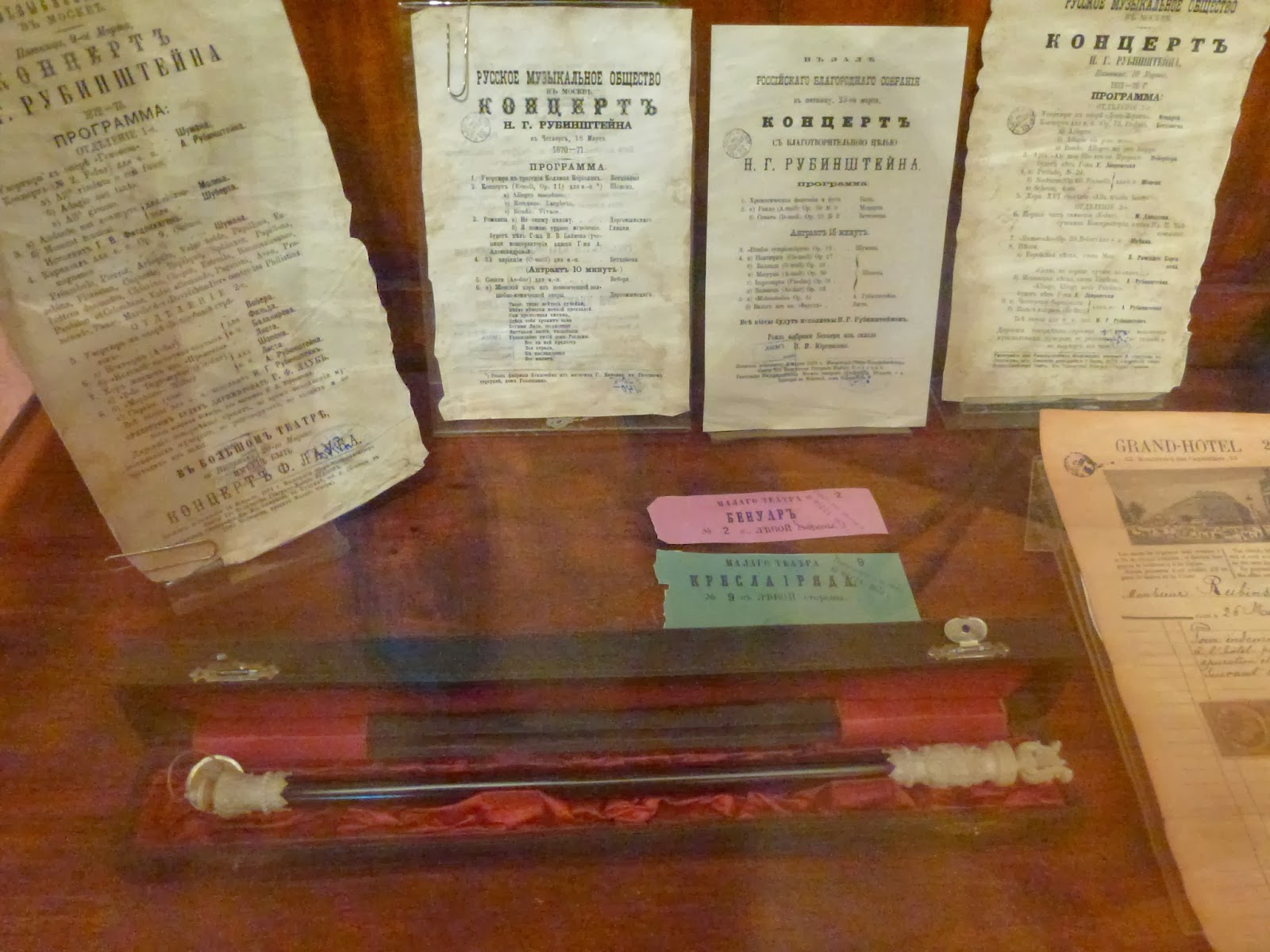
Although similarities between the two abodes abound - the shiny, black piano, framed photographs of his friends on the wall, and furniture of the same kind just as in Klin, on display in this apartment were two separate cases containing the personal belongings of Nikolai Rubenstein and Pyotr Jurgenson.

I was particularly excited to see Rubenstein's baton, a versatile man whose activities were not limited to that of pianist, conductor and teacher, but expanded to co-founder and first director of the Moscow Conservatory in 1866. His brother Anton Rubenstein, pianist and composer as well, founded the one in St Petersburg. Nikolai Rubenstein and Pyotr Tchaikovsky are said to have lived together for five and a half years during which their professional relationship and friendship flourished. Tchaikovsky held the position of professor of musical theory and harmony at the Moscow Conservatory when it opened - the second oldest in Russia, and is named after him.

A small treasure in Moscow like many others which the caretakers will be happy to talk to you about if you can speak Russian. Otherwise, there are printed leaflets in English of scant information in each room which are readily handed out.

Sunday, February 2, 2014

Tver - Gateway to Moscow

Adam stood shaking his hands to get some warmth back into them - his elegant, Italian leather gloves more of an adornment, rather than fulfilling the purpose he'd purchased them for. A burly, elderly man laden with bulging plastic bags stopped to address us with a smile, "Da, da, russkaya zima." We both burst out laughing; a remarkable effort, tensing and stretching the skin on our faces to cracking point. He was right; "Russian winter." Ironically though, it wasn't winter yet, not by the calendar anyway. It was still fall, but it felt no different from a very cold, winter day. On our way from the train station to explore the city, I wondered about the chore that lay ahead of us in the very low temperatures - sight-seeing.

Treading on lumps of ice and piles of snow, braving sub-zero degrees weather for the sake of exploring a city, required more than willpower. Even determination came short of what was required to embark on a journey of that kind. Reminiscing about the trip a few weeks afterwards, Adam admitted that the walk back to the train station was very tedious - it was unbearably cold, the walk was difficult and interspersed with the occasional slips threatening to send you onto your rear-end, not to mention the laborious effort of trying to keep our extremities warm. I was relieved to know I was not the only one who had felt that way. The next morning, I was so sore, it felt like I had tried out a new sport using muscles I didn't know made up part of my body.

Everyone I had mentioned visiting Tver to gave me a quizzical look. One person said she'd been but had not enjoyed it, another person from a town close to Tver recommended visiting another town, others just said it was a waste of time as there was nothing to do there. Curiosity had gotten the better of me, fuelling my inner drive to make it in time for the 08:09 train leaving Leningradsky Vokzal, to embark on the two and a half-hour journey to Tver. As I made my way there, I thought, "Who wakes up in the middle of the night in winter weather, in Moscow, enough said, to visit a town no one else wants to go to?" There ended up being takers on that one - another victim and myself.

Surely, to have several locations in Moscow named after it, Tver must be of a certain significance in Russia, at the very least in history, I thought. Tverskaya Street in the trendy part of Moscow, Tverskaya metro station leading to the trendy part of Moscow, Tver Hotel now taken over by a well-known multinational chain, but with a preserved air of the bygone era, Tverskaya Zastava, a square in front of Beloruskaya metro station... and possibly a few other places I don't know about yet. There had to be a reason why these places were named after this town. Not to mention that the Sapsan, the Russian high-speed train between the two largest cities in Russia, Moscow and St Petersburg, makes its only mid-trip stop in Tver.

Despite my reasoning, whomever I asked, gave me a similar response: "There's nothing there worth seeing." "There's nothing to do there." Needless to say, my invitations to explore Tver were mocked or met with raised eyebrows - "What on earth for?" Well, Catherine the Great certainly thought it fit to build a palace there for a stop while traveling between Moscow and St Petersburg. The said palace is currently under renovation. She is said to have actually donated a million rubles to build the road her carriage would travel along, known as Million Road.

One of the conductors on the train, a friendly one, asked if we were tourists visiting Tver. He must have been as baffled as others who could only surmise our mission at our  destination. I confirmed his suspicion and complimented him on his English. He mentioned that he'd lived in India for three years as a member of Hare Krishna. With his current full head of dirty blond hair, dressed in a heavy blue uniform, I had difficulty picturing him with a shaved head, robed in a saffron sheet, metal bowl and pestle in hand, chanting rhythmically in a language unknown to me. There was no time to chat, unfortunately, about his experience in India and why he had made the swap back to Russia.

Off the train, finally in daylight, our initial goal was to head for the cafe recommended by a woman on the train who had changed seats to be closer to us. She had heard us speaking English and wanted to be closer to get a chance to exchange a few words with us, or so I supposed. When she did get the chance, she inquired about the purpose of our existence in Russia, which initiated an exchange of impressions about Russia and other places. A native of Tver working in Moscow, she was able to recommend a cafe where we could have lunch and was adamant about us trying the strudel, a specialty of Tver, she informed us. Her response to our request of things to see though, unlike her recommendation for the strudel, was devoid of enthusiasm.

We stopped at a book and stationary store on the way, indulging in what it had to offer. Books are generally very reasonably priced in Russia, and are my weakness. A few greetings cards and some books afterwards, we had managed to warm up a bit, catch our breath and were ready to make it back outside. Bundling up tightly once again, we made it out onto the street ready to trek to our destination - 'Mon Cafe', as recommended by the lady on the train.


Braving the elements and following the map we'd just acquired from the bookstore, we headed to Tryokhsvyatskaya Street, a pedestrian area lined with shops of various merchandise - some open, some about to open, cafes, restaurants and a lively crowd. Further down, we came to the real star of this area - a bakery dating from the 19th century. It certainly warranted a visit. The facade clearly portrayed the era of its heyday. Inside, it was more than just a bakery. Traditional baked goods of all kinds clearly dominated the store in addition to two small round tables with chairs for a quick snack and drink . However, groceries, cold cuts, packaged goods, teas and coffees of different brands had now made their way into the no-longer-exclusively bakery. Nonetheless, the star was the bakery section - cookies, strudels, biscotti, buns, breads of different grains ... all much better priced than in Moscow. Needless to say we stocked up; in my case more for gifts than for personal consumption, and had a well-needed warm drink to tackle the next leg till we reached our destination.

In addition to the variety of goods as an attraction, one of the walls was decorated with pictures of various stages in the life of the bakery. Staff in different era identified by the fashion of their clothes stood in line for these stills in black and white immortalized in frames. Just like the country, it had experienced its fair share of change from before, during and after royal, revolutionary, socialist and current times. It was a significant discovery that neither the conductor nor the woman on the train had mentioned; once again showing what individuals consider worthwhile or not. It had been another stop to warm up.

Back on the street, we encountered an old man on a bench, feet on frozen snow surrounding him, playing a well-known Russian folk song with a catchy tune on an accordion. I have always considered street musicians in Russia very brave, but then again, they are a sturdy bunch. Most people walked past him. We stood for a short while to enjoy the song, keep him company and drop a note in his pan. He rewarded us with a warm smile which must have emerged from the depth of his heart. Wrapped in layers of clothing, topped with a fur hat as his bare fingers nimbly glided over the buttons and his arms extended and contracted the flexible instrument, he did not object to a picture and asked us to come back soon.

The third stop didn't warm us up and we were still a fair distance from the recommended cafe. The pedestrian street opened on to Soviet Square, the arts area, with theaters forming a semi-circle and Lenin ingratiating the passers-by from the other side of the square in a salute from his extended right arm. We were finally in the town center. Million Street, now Soviet Street was not too far away, and neither was Mon Cafe, but we made a stop at a church before finally walking through the doors of the place where we would spend a couple of hours recovering from the walk and the cold.

I had assumed it would be a short and straightforward from the station to the cafe, and then to the river bank along which all the sights are located - the reality was quite different. It was actually tempting not to spend the rest of the day in the comfortable chairs, making order after order of dishes, which would cost about three times more in Moscow, served by staff friendlier than I am used to.

I certainly tried the strudel, two servings - blackberry and apricot. They were both delicious. Tea. Shakes. More tea. My companion had coq-au-vin which he raved about - not only because of the taste, but the price for such a succulent dish. Soft, freshly-baked rolls. More fruit shake. Tea. Eventually, we had to get back outside to see what Tver was about and fulful our purpose of the trip. We piled the layers back on and once again ventured out into the cold unknown.

We crossed the road and waited for the woman on horseback to pass before we walked through the gate to the park. It was all covered in snow - the trees, benches, monuments... we even made and threw a few snowballs. The sunny weather brightened the cold walk to the 3,530-kilometer Volga river on its way through Tver to meet its diminutive partner the Tvertsa. The chance to see another monument of Pushkin standing quietly, full of purpose, people-watching, in his top hat and coat, legs crossed, leaning against a metal railing as he had done from time immemorial, and the neoclassical buildings reflected in the water by the sun up high were enough to make the trip worthwhile. It was quiet in the park and the chance to take in this view undisturbed was priceless, except when Adam decided to roll down the hill almost into the water because the soft, powdery, fresh snow was simply irresistible. He paid the price alright, as the snow covered his thin jacket, got into his clothes, stuck to his skin and dampened his clothes for the rest of the day.

The embankment, considered the heart of the city, is lined with neoclassical, pastel-colored, 18th century architecture, as well as trees and parks of statues. A monument to Afanasy Nikitin, a native of Tver is a graceful addition on the embankment. He is said to be one of the first-recorded Europeans to go to India, penning "Journey Across Three Seas" which became a famous travelogue. He stands astride, facing a long-spire church which seems to be the style favored in Tver, over the onion bulbs.

Two other significant monuments in Tver, in my view, are the two bridges which straddle the Volga. We managed to walk across them both in different directions enjoying the views of the city from different angles, admiring their reflections in the water. After short visits to a couple more churches, it was time to head back to the station. It is this walk that will stay engraved in my mind, and as I walk around certain parts of Moscow in winter, such as my neighborhood, I am forever reminded of that day in Tver.

With no more enticing pit-stops on the way back, the walk from the embankment in Tver to the station was not only long, but painful. The beautiful sun which had kept us company during the day had set. It was bitterly cold. The roads had not been cleaned and what seemed funny at first on our way in as we slipped and laughed was funny no longer. It was a task of endurance. My state of relief back at the train station was immeasurable.

It had been a pleasant adventure, but one that I am in no hurry to repeat, although I will remember the friendliness of the natives of Tver very fondly. I felt for the elderly in Tver, and in many other towns across Russia in similar conditions for several months of the year. I wondered if they would be used to it having lived there all their lives. I feared for them falling, and the conditions a fall on ice would leave them in. I remembered the heavily-laden elderly man who had cheerfully addressed us earlier on in the day as he walked on the same road I had incessantly complained about.

On the other hand, I saw young children running, jumping and skidding on the same ice that I was treading carefully. Maybe I needn't worry after all. These people are resilient and can take it all in stride, no pun intended. They made it through serfdom and Soviet times under the name Kalinin. It must be in their genes, so I think my concerns may be unfounded.

The 160-km train journey back to Moscow was uneventful. Not many people were rushing back to Moscow on Saturday night. However, our companion on the way in, who recommended Mon Cafe ended up being on the same train back to Moscow as us. Her plans had obviously changed as she had mentioned that she was staying for the weekend.We nodded in acknowledgment to one another, but this time we sat in different cars. Tver had taken all I had and I was in no mood for polite conversation. My joy new no bounds when I turned the key in the door to my apartment and limped to my bed.

Monday, January 27, 2014

Hidden Treasures in Moscow

It's all here, for all tastes; museums, art galleries, restaurants, cafés, theaters ... Moscow is a lot of things, but never boring. Offering infinite opportunities to savor culture in all its forms, sometimes these places are not easy to find. From alley way to alley way, buildings numbered haphazardly, not very helpful GPS devices, passers-by who have never heard of the place you may be looking for...but eventually you make it there and marvel at the magnificent spectacle before you.

One such place is The Moscow State Museum Bourganov's House in the heart of Moscow, not too far from Arbat Street. After you have finally found the place, at the sight of the nondescript entrance, you first wonder if the hard work was worth it. But once you venture in, you don't need anyone to answer the question for you. One look around and you know you made the right decision to visit 15 Bolshoy Afanasievsky.

The small door leads into a small reception area and a minuscule bookshop, where a small fee of 100 rubles gives you access to an open-air museum. A plethora of life-size sculptures of feet, hands, eyes, waning moon busts, busts with different motifs await to be admired. I couldn't help thinking I had walked into the world of a Russian Dali. Not having any initial expectations, my first impression was greater than what I'd felt going to the Dali Museum in Cadaques.

Unlike the time in Cadaques, where I wondered around comfortably in light clothing, here it was the beginning of winter. All bundled up, devouring these masterpieces, my fingers turned numb from the endless clicking to immortalize my visit. Despite the discomfort, it was difficult to leave. Every step led to another wonder.

In one building we met a kind security guard who took us behind the scenes to show us the work of restoration going on and where new works of art were being created. The shelves were stacked with a variety of art works amid the chaos which usually characterizes a busy art studio. He showed us around the temporary exhibition of canvases imitating a version of impressionism - unfortunately the gloominess depicted in the paintings did not help much to brighten the atmosphere. A small basement featured an atrium where a framed print of Dali's "The Great Masturbator" as well as smaller versions of the life size sculptures featured outside were on display. A few chairs gave it an appealing air of a quiet reading-room where you'd be surrounded by valuable creations.

And it went on. Shoes, bathtubs, arms, chairs...the neighbors whose windows looked onto these sculptures, in my eyes, were some of the luckiest people in Moscow. Living in the heart of the city with a view of exquisite art; waking up and going to bed with a view over spectacular beauty.

Two hours later, we finally made it back to the warm reception area where we engaged in conversation with the friendliest museum attendants I'd ever met. The receptionist showed us what was on sale - some very expensive jewellery, but also some very affordable books and calendars. In the course of our interaction, she informed us that a few years ago, Pierre Cardin had brought his models to this museum for a photo shoot. She showed us the pictures of the event published in a coffee table book; very impressive. I had no difficulty imagining the whole setup of elegant models in elegant clothes posing by, on and among the surreal sculptures.

She also told us about the artist himself and his beginnings. "The killing of a bird" is apparently partly biographical, explaining the ideas behind the works of art Alexander Bourganov had created. I bought the book to get some more insight into it, making a note to inform others about its existence. The art teacher at my school was grateful to receive the information and mentioned a possible field trip with her students for exposure to more works of art. We had been told that it was visited more by foreigners than by Russians, sadly. The bronze Pietà was my favorite - the loose folds of fabric and the semblance of a body lying across the mother's lap is a heart-wrenching sight.


Alexander Bourganov's works are spread all over the city. The walk from Kievskaya metro station to the Radisson Hotel, formerly the Ukraine Hotel, with a restaurant on the 29th floor and the Mercedes bar on the 30th, offering some of the best cocktails in the city, takes you through a park showcasing beautiful sculptures. The first time I ventured onto the park, I was happy I had my camera - a fountain with a highly-perched golden angel drew my attention, as well as other more somber bronze and stone sculptures. I wondered about the fortunate dwellers of the apartments overlooking these magnificent works of art.

Similarly, a walk in Arbat street takes you past the golden Princess Turandot and the Pushkin couple in front of which tourists and Muscovites alike are forever striking a pose. The beauty of these works of art are irresistible and one cannot pass by without devoting a few minutes to admire them. I was to find out after the visit to The Moscow State Museum Bourganov's House that all these works of art are Alexander Bourganov's as well.

He is still alive and well, still working, still creating, I was told. The attendants were just too happy to have someone to share this information with.

After a morning feeding the soul, it's time to feed the body, and take in another form of art. Pioneer movie theater in Kutuzovsky offers movies, good food and food for the mind. I'd been told it was a theater where movies were shown in the original language, but I hadn't been told about the décor. I can't imagine its size as a movie theater if it has now been refurbished and fitted with a restaurant on two floors and a bookstore.

With the low temperatures outside, I appreciate the opportunity of several activities under the same roof, not to mention that anywhere I can find books is my personal haven, and Moscow has lots of such places to offer. Dom Knigi on New Arbat Street and its smaller version on Tverskaya are my favorite hangouts. Pioneer Cinema in Kutuzovsky is another piece of treasure in this mine.

We chose a comfortable seat after trying two others and had the place to ourselves. Our kind, attentive waiter made the experience of a light meal before the movie a delightful experience - stir fry chicken, almond cookies, honey cake, mulled wine and two good servings of ginger tea, all promptly served in a welcoming atmosphere, honoring the taste buds. "All Is Lost" starring Robert Redford restored my faith in not giving up hope, extending the pleasant experience further.

A trip to the bookstore at the other end of the hallway with a 10-meter ceiling, at least, was a must. The three chandeliers of elaborate work on the high hallway ceiling are probably the only vestiges of the Soviet-era after the building was refurbished. The small, well-stocked bookshop did not disappoint me. The only time I do not complain about prices in Moscow is when I buy books; be they in Russian or English, and this time was no different. I bought a text book "English for Banking" for 38 rubles, and a novel by an Indian writer for 137 rubles. My excitement knew no bounds as I considered the value of my acquisition - just about 5 dollars.

Meal - check, movie - check, books - check, and back out into the snow in double-digit, subzero temperatures. We retraced our steps to the metro station past the French signs on stores selling extremely expensive and unnecessary goods. La Cornue was a kitchen gallery, a pink velvet bedside table with very long legs was displayed in the window of Bonpoint, as well as a white dining table of indiscernible material and accompanying red velvet chairs, Fleurs de Paris informed passers-by that it was open 24 hours.

Finally, the Museum of Architecture which is just a stone's throw from Arbat metro station is worth a visit; if not for the display of the new plans to restructure the city, for the buildings themselves - three. The main building housing displays of new plans for the city on flat screen TVs offers a view of the classical, Soviet-style building - high ceilings, marble floors, elaborate chandeliers, shiny, wooden balustrade supporting wrought-iron rails as you go up the grand staircase, arch doorways, and in this case, frescoes on the ceilings as well as marble reliefs, contrasting tremendously with the flat screen TVs displaying ever-changing slides.
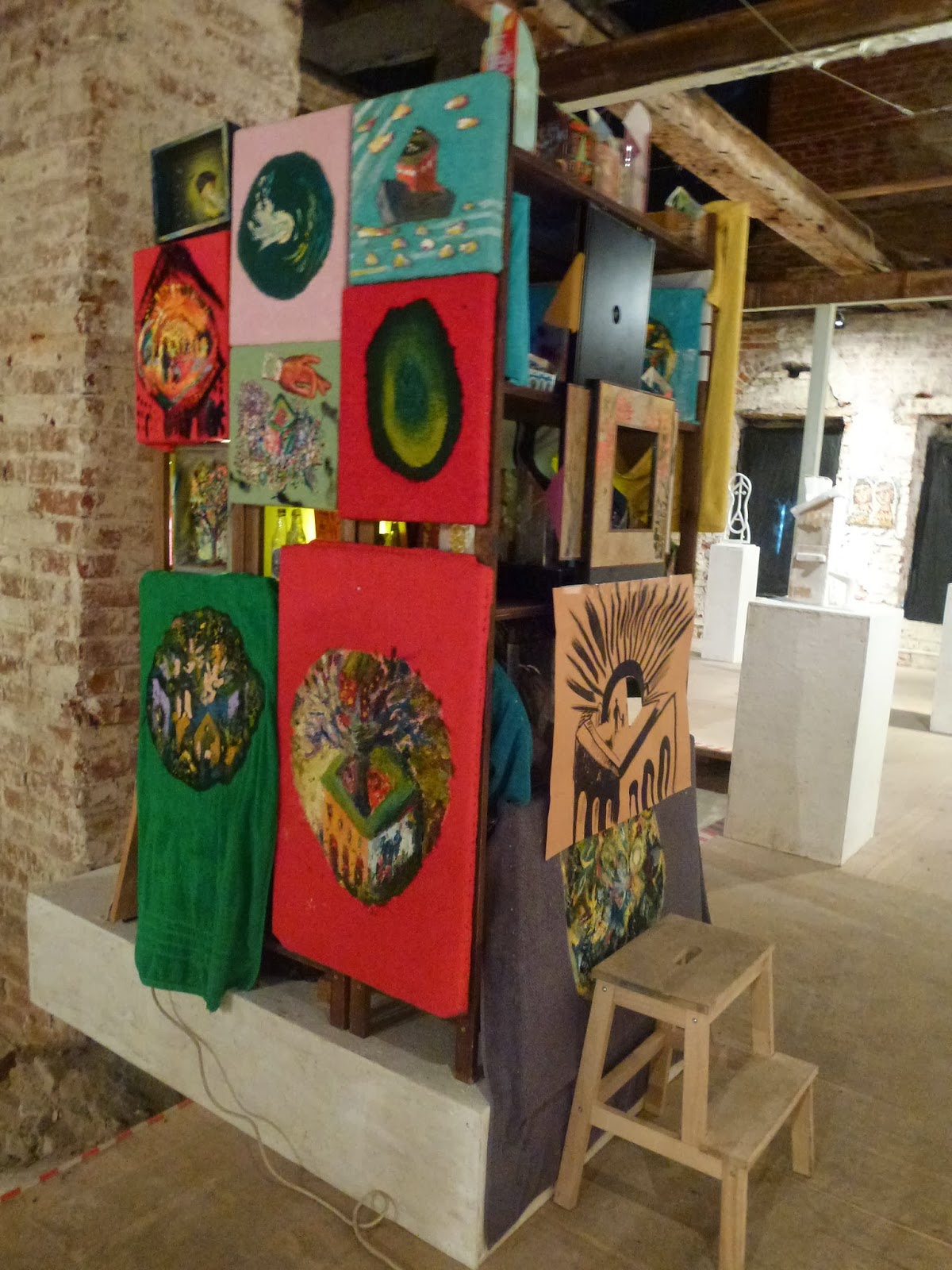
I was grateful to the woman for suggesting we put our coats on to go out to the next building. It had been gutted and offered no protection whatsoever against the biting cold which our coats had difficulty protecting us against. The exhibition theme was religious, and eclectic - naif-style, religious paintings, wooden, plastic and metal sculptures on wooden stands, fabric, and more of those underground. Following the religious theme, included in the display were several models of Orthodox style churches - some built from scratch, others restored. The main attraction was a laptop on a shelf shielded by paintings on multi-colored fabric - a small step ladder was provided to climb on to see what the electronic gadget displayed. Unfortunately, there were no attendants to offer any information and none was provided.

The third building, surprisingly warm, displayed architectural styles of buildings in Moscow inspired by or copied from those in other cities mostly in the Netherlands. Finding the buildings in Moscow would be difficult as no addresses were provided. All in all, it had been a worth-while visit during which we spent over an hour admiring the various displays.

These are just three of the several treasures housed in this megalopolis called Moscow.

Monday, December 2, 2013

Small Town, Big Parade - Yaroslavl

The parade had ended, enabling the soaked dignitaries, most likely chilled to the bone, to finally disperse. The forlorn lectern on the rolled-out, T-shaped, red carpet with golden borders offered an unusual view. There was no one on the carpet which lay soaked on the ground in the incessant drizzle in front of the grey, Soviet-era, block-shaped building with the scythe and sickle boldly emblazoned on each side, shielding the bear carrying a tied bundle at the end of a stick. The bronze bear must have been added recently as the story behind it pre-dates Soviet times.

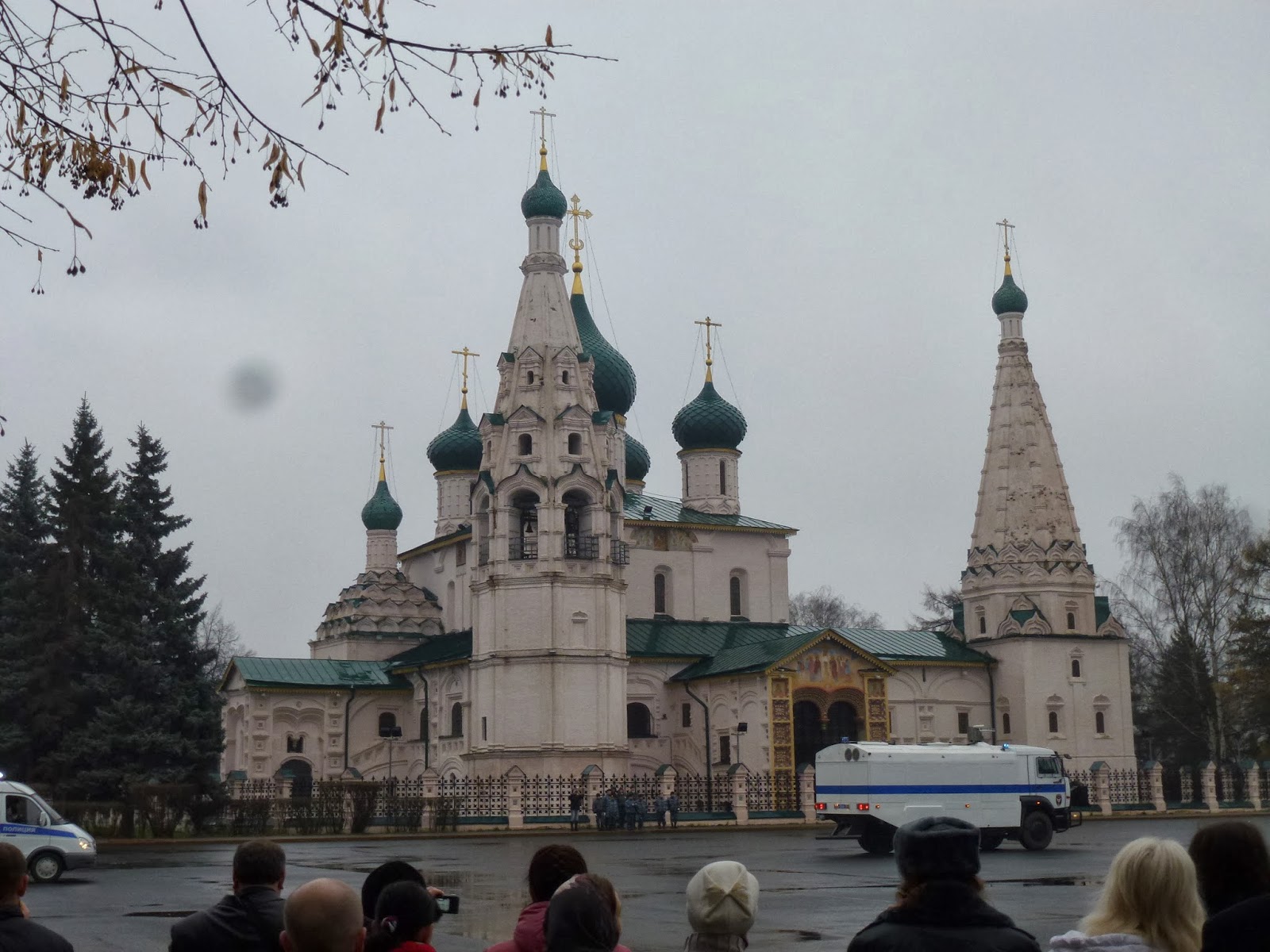
Across from the wide square and the modern building, was a replica of a multiple, green-domed white church I had seen in Kolomenskoe Park, the royal retreat in the apple orchard outside Moscow - a reminder of another visit.

The big boys had been recruiting more boys to come and join them play macho games with their big toys. Or so it seemed from the parade of companies or battalions followed by police cars of different sizes and makes, military trucks and tanks and a myriad other big vehicles. We managed to catch a view of the last cadets and officers marching through the square to the dynamic rhythm of a marching band, as a loud speaker blurted out the names of the companies and invited others to join this exclusive brotherhood of municipal, regional and national defense. All through the light drizzle, men, women, families, children sitting on the shoulders of their loved ones stoically and silently watched the parade embodying respect for the demonstration of such power.

Yaroslavl, where we'd gone for the weekend is a leisurely, three-and-a-half hour train ride from Moscow. The scheduled train rolled out with admirable punctuality; so much so that one of my co-travelers who made the mistake of arriving a few seconds after departure time was left behind. We found our seats easily in the last car and slid cozily into their warmth in contrast to the wet weather outside, making for a nice opportunity to catch up on sleep we had been deprived of due to the early departure.

Our initial goal, upon arrival, was to find our sleeping quarters, leave our luggage, have breakfast and then tour of one of Russia's oldest towns, which in 1612 had had the honor of being the capital of the Russian state for about two months. Having celebrated its millennium in 2010, it is slightly older than Moscow, which is just a bit short of 900. Included in the UNESCO World Heritage list since 2005, its historic center boasts numerous, beautifully restored churches accentuating the traditional air so typical of the Golden Ring towns in Russia.

From the train station, we walked along Chekhov Street to a nearby hotel we hoped would serve us a well-needed meal as it was almost noon. Our excitement heightened with every step towards the hotel as we imagined a warm restaurant with a smorgasbord to fill our plates to our hearts content; what with the weather, our hunger and anticipation was immeasurable.

Had anyone managed to capture the disappointment on our faces as we were informed by the security officer that there was no such place for dining at the hotel, not even a coffee shop, we would have made the front page of the Yaroslavl Times. A hotel, in a tourist town of such prominence, without a simple coffee shop, was difficult to digest. Dejected, we plodded away with heavy hearts and empty stomachs in the hope of finding a coffee shop in the vicinity. We didn't. The only attraction in sight was the old cemetery that the hotel rooms looked on to. An imaginary conversation between a visitor and reservations clerk played in my head - "Cemetery view from your room, or...cemetery view?"

We continued our walk along Chekhov street, past the cemetery, a jacuzzi tub sales center, old houses, tram tracks...no coffee shop in sight, nor anything remotely offering sustenance.

The sophisticated hand-held device informed us after 3 kilometers that we had another 3 kilometers to get to our chosen accommodation site to leave our bags. The general consensus after the disappointment, the long walk, and the further exercise that awaited us was to get ourselves to the town center instead, where the likelihood of finding a place to sit, eat and rest before tackling the tour seemed more plausible.

We waited at a stop for a bus headed in that direction and boarded one after about 18 minutes. Held up in traffic close to the town center, we finally found out why - a woman who had been run over was being carried into an ambulance as she lay face-down, fully-clothed on a gurney. My thoughts went out to her. As much as I'd complained about breakfast, or its lack thereof, the walk, and everything else, at least I was on my own two feet. I wished her a speedy recovery as I realized how lucky I was. The scene reminded me to be careful while crossing.

Finally we arrived at our destination to be welcomed by vestiges of the products of the legendary revolution - Soviet Square, October Street... and right in the vicinity, oh joy, a coffee shop promising a spread. We entered the Travelers' Cafe and sank into the soft seats like the weary travelers that we were. Always an interesting experience, the order and service did not disappoint us, with the lengthy service, the wrong order, the cold gazes and the accompanying squabbles. I am now used to it and just take it all with a pinch of salt.

Our first stop as tourists, once well-fed and after walking along a boulevard bearing a name commemorating the Soviet era, past a colorful collection of birdhouses in bright pink, purple, white, blue and emerald green all nailed to a tree, was Volkov Theater in Volkov Square. The pastel yellow building with white columns, typical of the neoclassical architecture found all over Russia, looked newly restored, sporting a fresh coat of paint. Both are named after the founder of Russia's first public theater, Fyodor Grigorievich Volkov.

We walked around, past Blaise Tower and to the pedestrian area with chain stores, a beer den or two, churches and several monuments. My friends, like most Russians I am acquainted with, are not particularly interested in entering churches. This has been conveyed to  me in different ways: "I don't have a scarf." "We can't go in wearing pants." Or simply more directly, "there's nothing interesting to see inside." As such, I only admired the churches from the outside.

More churches, more church bells, more golden domes, more pastel yellow buildings and their corresponding white columns, as well as the omnipresent eternal flame with wreaths deposited by thoughtful visitors. Bordered by the Volga and Kotorosl rivers, we walked along the embankment as the weather warmed and dried up in the afternoon. In the midst of all the history and the pleasantness of it all, I felt bewitched by the spell that the beauty of the historic town center seemed to have cast on me. The summer months long over, there were no cruise ships at the harbor as the guide had specified.

There wasn't a single moment during which the gigantic "I heart Yaroslavl" sign did not have someone posing in front of it. Standing in line for a souvenir did not appeal to me so I took a rain check. Good weather being hard to come by, I thought I'd make the most of what we were lucky to get. The one picture I had taken of myself was with my hand on the man-size rock displaying the inscription of the founding of the town with the monument of the Holy Trinity erected in 1995 in the background.

As we returned into town after wearing out the soles of our shoes for a few hours, we heard church bells. It was four o'clock and the faithful were being summoned to mass. We approached the church and stopped to listen to the musical chimes which, to my surprise, were the product of a woman's expertise. It was the first time I'd seen a woman in the belfry instead of the usual long-haired, long-bearded, black-robed, kamilavka-donned priest. We looked up at the woman in a black dress and headscarf, enjoying the music her hands so deftly played, as she looked down at us. And I was sure she could see the "box of chocolates" a prankster had left on the ground trying to lure fools in pursuit of satiating their gluttony, subsequently disappointed as they discovered the trick. The bell concert lasted five minutes exactly - five minutes of musical bliss.

We resumed our walk back to the pedestrian area, where we found a place for a snack as we prepared to accompany our friend who was returning to Moscow that evening. Night setting in early, there was little else to visit at the end of the day so we decided to watch the latest Russian release in the movie theater, about a geography teacher who regularly enjoyed a couple of drinks too many, and then have dinner.

It had been a tiring but rewarding day with lots of interesting sights in great company. And now to find the accommodation we had tried to get to when we first arrived several hours ago.

The next morning we made our way, once again, and for the last time, to the pedestrian area. "Le Gavroche,"
which we later discovered was the in-place in Yaroslavl for a meal, is where we found a booth and settled in ravenously. It was decorated beautifully with semi-open, rich, dark curtains bunched up on the sides, revealing the on-goings on the street, or in this case, the none-goings. Framed pictures of Yaroslavl at different times in history gave the coffee shop a homey feeling. Posters of different beverages vividly indicated the business the place was in. Very few tables were occupied with people generally talking in hushed tones. It seemed the perfect place to spend some time in the morning before heading back to Moscow.

Omelette, pancakes with sour cream, broth, strudel, croissant, fried eggs and ham, tea...we seemed to be celebrating; such was the sumptuous breakfast we regaled ourselves with. It seemed very quiet; quieter than a normal Sunday morning. There didn't seem to be many people walking outside either. We later saw the whole town gathered at the square watching the big boys' parade with their big toys and understood. We had arrived in time to take part in the end of the event, listen to the officer calling upon the brave to join the forces, and for the barricades to be lifted so we could walk through and discover what was left on our list.

We walked past a posh grocery store, which time did not allow us to explore, on our way to the Monastery of the Transfiguration. It is, according to the guide, the best place to start a tour of Yaroslavl. However, we had left that for last - the thick, white-washed walls, arches and brown-roofed towers at each corner, vividly reminiscent of other monastery ensembles all over the country. A sign at the entrance informed visitors of its status of a UNESCO World Heritage site charging different fees for access to different sites within the ensemble. "Masha the Bear" was on display for a few hours in the afternoon for a few rubles. Did she dance? Ride a bike? Skip rope? What tricks, I wondered, did she do enabling her to be on display? But, alas, I didn't have the chance to witness it.

A light, constant drizzle filled the air as we paid a small fee for the privilege of visiting the grounds, but not the finest creations of medieval Russian art housed in the churches. I promised myself I'd do that on another occasion. It is said that nothing of the Kremlin survived when it burnt down in 1658, nevertheless, a collection of beautiful churches and monuments make it worth visiting. I hadn't managed to see the Abbott's Chambers, the Refectory, the Holy Gate and other recommended attractions, making a visit back paramount.

We bade farewell to Yaroslavl the town, and to Yaroslavl the Wise, whom we have the good fortune to see every time we spend 1000 rubles. In the town, he is cast in bronze and was erected in 1993, holding a model building in his left hand.

We made it back in time for the train, which once again left promptly with no announcement whatsoever. Busy playing scrabble, scattergories and reading, the train ride was over in the blink of an eye, as was the weekend.

Friday, November 22, 2013

Culinary Delight in Moscow

The menu was one of a kind - a wooden chopping board with a spoon and clip holding together, the intentionally dog-eared-I-presume, brown sheets listing the variety of meals and beverages available for degustation.

I ordered borsch, roasted beetroot and goat cheese salad, and pear strudel, all to be washed down with lipa leaves tea after a refreshing pear duchess [pronounced dyushess] with dried, poppy-seed covered bread snacks.

I had seen these minuscule white flowers blooming all over the city as the more favorable weather set in, but took no particular notice of it until a friend pointed it out to me on a trip outside of Moscow. Several ladies, plastic bag in hand, were filling these with the flowers attached to the budding leaves they plucked off the fast- bloomed trees after the long, longed-for defrost. "Lipa!" my friend remarked. "My grandmother used to make lipa tea all the time. Seeing these women reminds me of the pleasant aroma which filled the house when I visited her." The flowers are picked, dried and stored for use during the guaranteed, cold winter months. That was another item to add to the list of novelties I was experiencing in Russia, but had not been fortunate enough to taste till I could order it in a restaurant.

I took a few sips, actually gulps, of the chilled, sweet, carbonated soft drink which arrived first as I settled down to recover from the effects inflicted by the laborious task of finding Mari Vanna; a quaint, picturesque Russian cuisine restaurant in the heart of Moscow, not too far from Partriarch Ponds and the Tchaikovsky concert hall.

It had been one of those days in Moscow, with intermittent rain. And the restaurant had been one of those places - difficult to find. We had spent what seemed like endless hours, although it may have been only a few minutes, going round in circles looking for a sign signalling the name of the restaurant on top of an entrance we would walk through. But we were always at the wrong place. It helped that we were in the company of a Russian friend, so we didn't feel totally useless at finding a clearly stated address in this, at times, labyrinthine megalopolis.

We were in the right vicinity, in the right street, and at the right number, but saw nothing resembling an entrance to a restaurant. We asked on two occasions and were directed on both with the help of information provided by a sophisticated, hand-held communicating device - all to no avail, since neither got us there. Finally, we asked a man who had come out of a door for a smoke. After a long drawn puff, he startlingly informed us, "You are standing in front of her".

It took me a few seconds to recover from the shock, hoping he wasn't referring to himself - short, stooped under the awning, shielding himself from the pouring rain, cigarette in one hand, the other warming itself under his armpit. We looked up, and around, and still saw no sign. In the dark, we had missed the collection of old door plaques engraved with Russian last names and matching doorbells - their version of a sign; still no Mari Vanna sign in sight . There might have been about thirty to fifty of them. Would pressing any of the bells had led us to the right place? I could never find out as it didn't occur to me to try it.

Refreshed, rested and recovered from the ordeal, I made my way to the ladies room to wash my hands before tackling my meal. As I stepped into the restroom, I couldn't help but feel transported back into another epoch. I had been looking for signs of the bygone Soviet-era in different places unsuccessfully, as modernized Moscow aspires to be western, international, depriving me of the sights I hoped would represent and remind me of that legendary time in history so unique to this great country.

The top half of the walls of the small room were papered in what represented pages from newspapers and magazines from that nostalgic time I'd longed to experience. A wooden, wireless radio from which French melodies emanated sat perched on a small shelf on the left as you walked in. Wooden, were also the seat and toilet paper holder. The water closet was placed up high as its white-knobbed chain dangled to within easy reach. A few framed pictures and other colorful artifacts on the walls livened the little room. A grey wooden box on the wall held two current Russian daily newspapers. Fluffy, white face towels, nicely folded had been carefully piled in rows on shelves under the radio. A mirror in a wooden frame hung on the door, and a wooden bin affixed beneath the hand-wash basin provided for used towels looked more like a decorative, than functional piece of furniture. It was warm and squeaky clean in there, and oozed of the homey, snug feeling one gets from being wrapped in a familiar comforter on a cold, rainy, winter night. If they had taken such care decking the toilet, what wonders would they have done to the eating area itself?

I'd been previously informed that dining at Mari Vanna's was like having a meal in a Soviet apartment. It
looked more like pre-Soviet, bourgeois era decor to me, as I'd seen in more than one house museum such as Pushkin's in Arbat Street. On my way back to my table, I stopped every few steps to admire and take in the set-up which was simply breath-taking. A round table in a corner, which could be reserved for an intimate family meal of four, was set with beautifully hand-painted dishes which seemed to have been imported from Limoges, and crisply-starched, off-white, rectangular-folded napkins underneath beautiful, sparkling crystal, ready to be occupied. A row of old sewing machines lined on the window sill beside this table accentuated the warm, homey feeling in every square inch of the walk down memory lane in this small restaurant.

Most tables were occupied - some by couples of same or mixed genders having intimate conversations as they savored their meals. Extreme satisfaction deeply etched in their facial and bodily expressions. Others were occupied by groups of adults or families, some celebrating an event, others just refueling at the end of the day. Some tables were in the process of being vacated as others were being occupied. The restaurant staff didn't have an idle moment to spare.

I finally returned where my two co-diners waited patiently at the white-lacquered table covered with a beige table cloth, on seats upholstered in the fashion of the start of the previous century. There was very little room left on our table crammed with myriad utensils occupying their due space - the rest of my drink was waiting for me, the lipa leaves were brewing in the plain beige teapot sitting at one end, our three cups and saucers of the same set as the pot also occupied their space. A glass bowl of dried snacks from which three hands took turns sat majestically in the center. How would our dishes fit?

No sooner had I formulated the question, than the answer was provided in person. One of those deep bottom round hand-painted dishes was placed in front of me, and the borsch I'd ordered was ladled into it from a casserole. I waited impatiently for my friends to be served their chosen first courses before I started the appetizing soup. One had another kind of vegetable soup and the other had boiled potatoes with baked herring sprinkled with parsley served in a deep oval dish - all very Russian. I kindly declined to taste their choices and took my first spoonful - it tasted divine! After almost two years in Russia, it was probably my second try of this typical Russian dish. I voraciously savored every spoonful and left the dish dry, as did my friends who similarly enjoyed their orders.

We enjoyed our second courses and commented incessantly on how tasty it all was, how efficient the staff were, how nicely the restaurant was decorated, how homey it felt and how it actually felt as if Mari Vanna herself had cooked the meal we were having in the kitchen down the hall. The section we sat in had been furnished with transparent cupboards filled with crockery - dishes of all sizes, glasses, teapots, cups, saucers and other utensils as would be found in a family home, in addition to various table artifacts. On the opposite wall, a wooden frame held a flat screen TV we paid no attention to. It looked down onto us from a height as we sat busily talking under a big abat-jour shielding the lamp from which three elongated bulbs illuminated our table and all of its contents.

My dessert tasted just like I wanted it - fruity, not too sweet and healthy, accompanied by cup after cup of lipa leaves tea. As good as it tasted, and as much as I enjoyed it, there was no story behind it, contrary to my co-diner's "naked heart" as it was called in the Russian menu, but plain "pigeon's milk" in the English one.
As it was explained to us, "naked heart" is the name of a charity association founded by a Russian top model now married to a Swiss mogul. A percentage of the proceeds from consuming this dessert goes to this children's charity fund bearing the name Naked Heart. It was presented on a large, flat, hand-painted plate in the design of the others we'd eaten in, in the shape of a heart set in the midst of a strawberry syrup-drawn heart surrounded by an assortment of wild berries so common in Russia, so rare it other countries, and mint leaves.

It had been a wonderful evening after a not-so-easy quest to find the restaurant in the rain. All that difficulty was soon forgotten after the welcoming atmosphere we entered which played French and Russian folk music throughout our dinner. By the time we were done with our meal and ready to leave, any inconvenience we may have experienced was completely forgotten, with a great desire to return soon to try other dishes and enjoy the same warm atmosphere.

The bill was brought to us in an old ladies' coin purse which had us all ooing and aahing at the cuteness of the purse and the originality of the idea. As we placed our due in it and clipped it shut, I couldn't help but feel that we were rewarding and thanking Mari Vanna herself for the wonderful meal, homey setting, beautiful decor, and transporting me successfully to another time in history. I have dined in several other restaurants in Moscow and none have impressed me as much as Mari Vanna, in the quality of food-price ratio, as well as service. Leaving was more difficult than I'd expected but the thought of returning made it more bearable.

The fat, furry, fluffy, grey ball of a cat that stood immobile in its basket on a shelf looking like a lifeless part of the decor, petted by all as they came in, was finally curled up in the same basket sleeping. Were it not for the almost imperceptible rise and fall of grey fur, it would be completely unnoticeable as it blended in so well with the home bric-a-brac carefully placed on the various-sized shelves of the divider. But people noticed as they walked by, petted, caressed or kissed it on their way out as they did on their way in. Were it ever removed from that restaurant it would not survive, already used to the attention of scores of hands extended from different visitors.

Sad to leave, I produced the wooden number plate to the cloakroom assistant who located my coat and helped me put it on. We couldn't resist taking pictures of the strings of dried vegetables hung in the foyer and the bicycle over the door frame. A must-see-and-do in Moscow. Umbrella back in hand, off we went retracing our steps with a spring in our feet.